

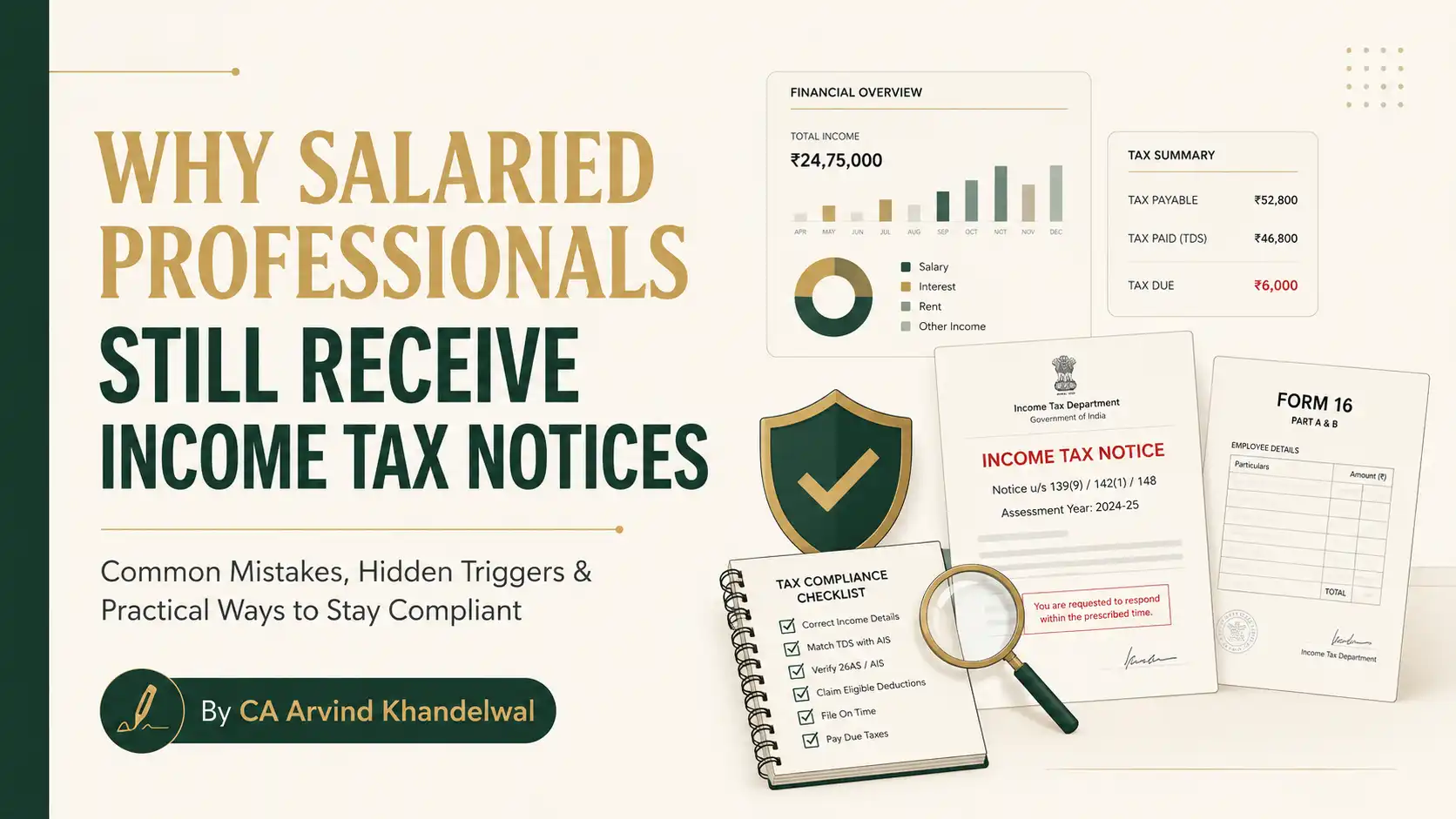
Why Salaried Professionals Still Receive Income Tax Notices
One of the most common assumptions among salaried taxpayers is that income tax notices are primarily a concern for business owners, high-net-worth individuals, or people deliberately avoiding taxes.
After all, if an employer deducts Tax Deducted at Source (TDS) every month and Form 16 has been issued, what could possibly go wrong?
Yet every year, thousands of salaried professionals receive communications, notices, or compliance alerts from the Income Tax Department. In many cases, these taxpayers have filed their returns on time and genuinely believed they had complied with all requirements.
The reality is that modern tax administration looks beyond salary income alone. Tax authorities increasingly evaluate a taxpayer's overall financial profile, comparing information from multiple reporting sources against what appears in the Income Tax Return (ITR).
As a result, receiving a notice is no longer necessarily linked to tax evasion. Often, it is linked to mismatches, omissions, reporting errors, or unexplained financial transactions.
Understanding why notices are issued is the first step toward avoiding them.
The Real Question Taxpayers Are Asking
Most salaried professionals are not asking whether notices exist.
They are asking:
"If my employer already deducted TDS, why am I receiving an income tax notice?"
The answer is simple.
TDS on salary only covers the information available to the employer. It does not automatically account for every financial transaction, investment, property deal, bank account, capital gain, or additional income source that may exist outside payroll records.
Your employer can calculate taxes based on salary disclosures provided during the year. However, the Income Tax Department evaluates information received from numerous independent sources.
When those sources reveal information that differs from the return filed, questions may arise.
This is why many salaried taxpayers receive notices despite having no intention of underreporting income.
What Has Changed in the Compliance Landscape
The tax compliance environment has changed dramatically over the past decade.
Today, the Income Tax Department receives information from:
- Annual Information Statement (AIS)
- Form 26AS
- Banks and financial institutions
- Mutual fund companies
- Stock exchanges
- Property registration authorities
- TDS reporting entities
- Foreign asset disclosures
- High-value transaction reporting systems
This means the department often has access to information that extends well beyond salary income.
For example:
- Interest earned on fixed deposits may be reported by banks.
- Capital gains may be reflected through securities transaction records.
- Property purchases may be visible through registration data.
- Dividend income may appear in financial reporting systems.
- Multiple bank accounts may generate information trails.
As technology and data analytics improve, identifying inconsistencies has become significantly easier.
Consequently, salaried taxpayers should view compliance as a holistic exercise rather than simply a Form 16 filing exercise.
What the Law Actually Requires
The Income Tax Act requires taxpayers to accurately disclose taxable income from all applicable sources.
While salary may be the primary source of income for many individuals, other income categories may also require reporting, including:
- Interest income
- Rental income
- Capital gains
- Dividend income
- Freelance or consulting income
- Foreign income, where applicable
- Other taxable receipts
The department may issue notices or communications when:
- Information available in AIS does not match the ITR.
- Certain income appears omitted.
- High-value transactions require clarification.
- Deductions appear inconsistent.
- TDS claims do not reconcile with reported records.
Importantly, not every notice indicates wrongdoing.
Many notices are informational and seek clarification or verification.
However, ignoring them can create larger compliance issues later.
How This Plays Out in Real Life
The Fixed Deposit Interest Oversight
A salaried employee files a return based entirely on Form 16.
Months later, a notice is received because interest income from multiple fixed deposits was not reported.
The taxpayer assumed that since TDS was deducted by the bank, no additional disclosure was necessary.
The Investor Who Forgot Capital Gains
A software professional actively invests in shares and mutual funds.
While salary income is correctly reported, gains from securities transactions are omitted.
The transaction data eventually appears in reporting systems available to tax authorities.
The result is a compliance communication seeking clarification.
The Property Transaction Mismatch
A salaried executive purchases a residential property.
The transaction itself may be legitimate, but the source of funds and disclosures in the return do not fully align with available records.
This discrepancy may attract attention.
The Multiple Bank Account Issue
An employee maintains several savings accounts across different banks.
Interest earned from smaller accounts is overlooked while preparing the return.
Individually, the amounts seem insignificant. Collectively, they create a reporting mismatch.
The Incorrect Deduction Claim
A taxpayer claims deductions without maintaining adequate supporting records.
Even where the claim is genuine, insufficient documentation can create difficulties during verification.
Where Things Commonly Go Wrong
Relying Exclusively on Form 16
Form 16 is an important document, but it is not a complete summary of a taxpayer's financial life.
Additional income sources must also be reviewed.
Ignoring the Annual Information Statement
AIS has become one of the most important tools available to taxpayers.
Failure to review AIS before filing increases the likelihood of mismatches.
Forgetting Interest Income
Interest from savings accounts, fixed deposits, recurring deposits, and other instruments is often overlooked.
Not Reporting Capital Gains
Many taxpayers mistakenly assume that small investment transactions are not relevant for tax reporting purposes.
Claiming Deductions Without Verification
Errors in deduction claims continue to be a frequent reason for scrutiny and compliance queries.
Ignoring Tax Communications
Many taxpayers panic when receiving a notice and avoid opening or responding to it.
Delayed responses often create bigger problems than the original issue.
What Businesses and Taxpayers Should Do Next
The most effective strategy is preventive compliance.
Before filing a return, salaried professionals should reconcile:
- Form 16
- AIS
- Form 26AS
- Bank interest records
- Investment statements
- Capital gains reports
- Property transaction records
This process helps identify discrepancies before the department does.
Taxpayers should also maintain documentation supporting:
- Deduction claims
- Exemptions
- Investment declarations
- Property transactions
- Significant financial receipts
Receiving a notice should not automatically be viewed as a crisis.
Many notices can be resolved efficiently when records are organized and explanations are available.
The real risk lies not in receiving a notice but in being unprepared to respond.
A Practical Compliance Checklist
Before filing your next return, ask yourself:
✓ Have I reviewed my AIS?
✓ Does my ITR match Form 26AS?
✓ Have I included all bank interest income?
✓ Have I reported capital gains correctly?
✓ Have I disclosed rental or other income sources?
✓ Do I have documentation supporting deduction claims?
✓ Have I reviewed property transactions during the year?
✓ Have I reconciled investment statements?
✓ Have I checked all TDS credits?
✓ Can I explain significant financial transactions if required?
The Key Takeaway
The assumption that salaried taxpayers are immune from income tax notices is increasingly outdated.
Today's compliance environment is built on data matching, automated reporting, and financial transparency. The Income Tax Department often sees far more than what appears in Form 16.
Most notices received by salaried professionals arise not from deliberate non-compliance but from omissions, mismatches, or incomplete reporting.
The solution is not complicated.
Review financial information comprehensively, reconcile reporting documents before filing, maintain supporting records, and address discrepancies proactively.
For salaried taxpayers, good compliance is no longer about reporting salary income correctly. It is about ensuring that every significant financial activity tells the same story across all records.