

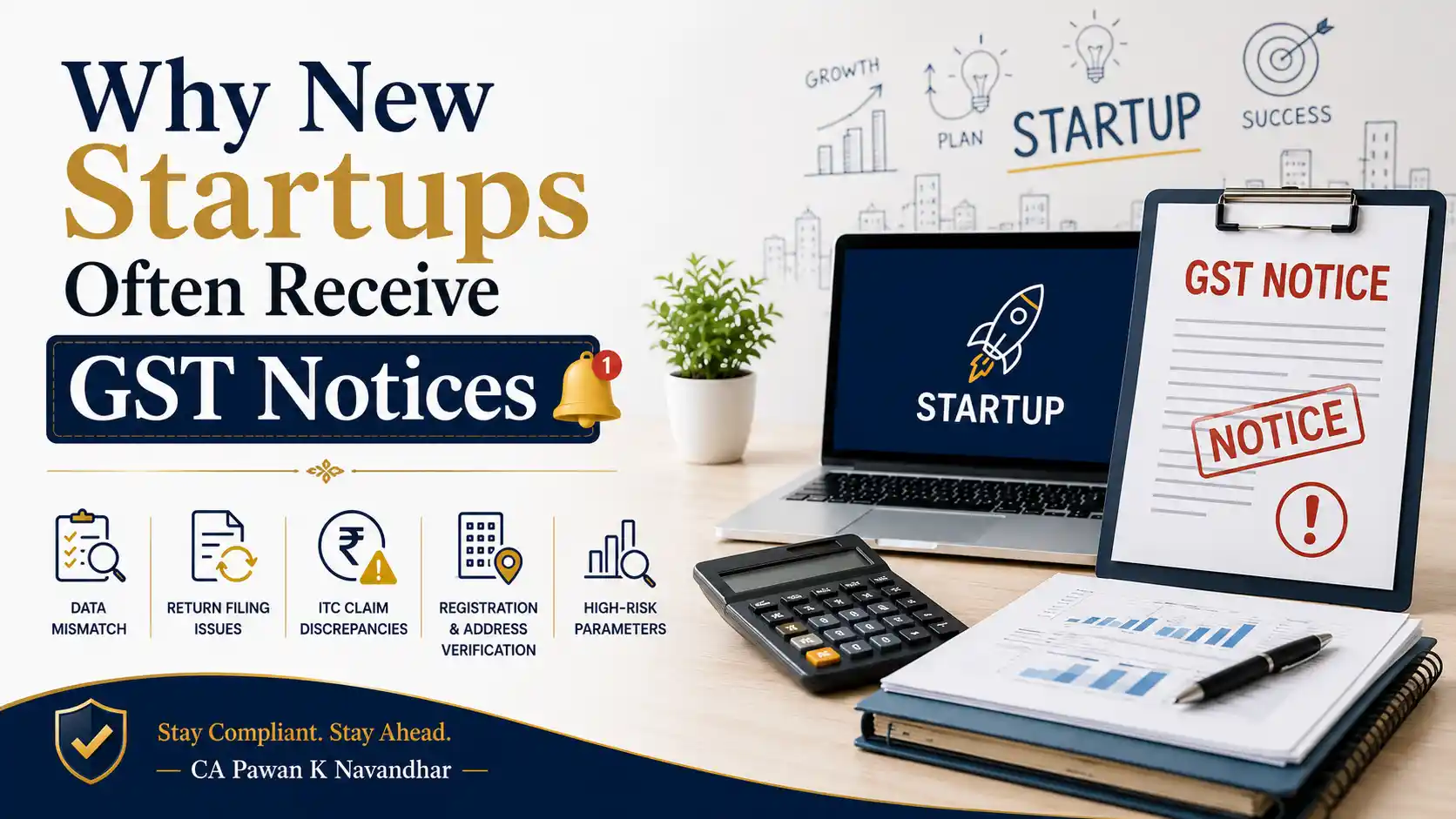
Why New Startups Often Receive GST Notices
Why This Issue Creates Compliance Risk
Launching a startup is exciting. Entrepreneurs focus on developing products, acquiring customers, raising capital, hiring employees, and generating revenue. In the early stages, compliance often takes a back seat to growth.
Many founders believe that GST notices are issued only when businesses intentionally evade taxes. In reality, most notices received by startups arise from routine compliance errors rather than deliberate non-compliance.
A missed return, incorrect invoice, mismatch in reported data, delayed tax payment, or failure to maintain proper records can trigger automated scrutiny. As GST has become increasingly technology-driven, even minor inconsistencies between returns, invoices, and tax payments can be identified through system-generated validations.
For a startup, a GST notice is more than just a compliance issue. It can consume management time, delay refunds, affect cash flow, increase professional costs, and create unnecessary stress during a critical growth phase.
The objective should not be to respond to notices after receiving them.
The smarter approach is to build compliance processes that significantly reduce the chances of receiving one in the first place.
Understanding the Tax Position
GST compliance extends far beyond obtaining a GST registration.
Every registered business is expected to:
- Issue GST-compliant tax invoices.
- File returns within prescribed timelines.
- Report outward supplies accurately.
- Maintain proper books of account.
- Pay taxes on time.
- Reconcile reported data regularly.
- Preserve supporting documents.
The GST system relies heavily on electronic reporting.
Information submitted through returns is matched with data available from suppliers, customers, e-way bills, e-invoices (where applicable), and other government databases.
When inconsistencies appear, the GST portal may generate alerts or notices seeking clarification.
Receiving a notice does not automatically mean wrongdoing has occurred.
In many cases, it simply means the department requires additional information or supporting documents to verify the reported transaction.
The best defence is accurate reporting supported by proper documentation.
Common Business Situations
Many GST notices originate from ordinary business situations that were not managed carefully.
Example 1: Delayed GST Return Filing
A technology startup becomes busy securing clients and misses several GST return due dates.
Although business operations continue normally, delayed filings trigger system-generated notices.
Timely filing could have prevented the issue.
Example 2: Incorrect GST Invoice
A newly registered business issues invoices missing mandatory details such as GSTIN, invoice numbering, or tax breakup.
Even genuine transactions may require clarification if invoices do not comply with GST requirements.
Example 3: Input Tax Credit Mismatch
A startup claims Input Tax Credit (ITC) based on purchase invoices without verifying whether suppliers have correctly reported those supplies.
Differences between supplier filings and purchaser claims may lead to notices seeking reconciliation.
Example 4: Business Address Not Updated
A startup shifts to a larger office but forgets to update its GST registration.
During departmental communication or verification, the outdated address creates avoidable compliance complications.
Example 5: Incorrect Classification of Goods or Services
A business applies an incorrect GST rate due to misunderstanding the classification of its products or services.
Although the error may be unintentional, tax authorities may seek clarification regarding the applicable tax treatment.
Example 6: Poor Record Keeping
A startup receives a notice requesting purchase records and tax invoices.
Because documents are scattered across emails, spreadsheets, and paper files, responding becomes time-consuming and stressful.
Mistakes Frequently Seen
While every business is different, several compliance mistakes appear repeatedly among new startups.
Treating GST as a Year-End Activity
GST is an ongoing monthly or quarterly responsibility.
Waiting until year-end to review transactions increases the likelihood of errors.
Depending Entirely on Accounting Software
Software improves efficiency but cannot replace proper review.
Incorrect entries entered into accounting software often result in incorrect GST returns.
Ignoring Vendor Compliance
Claiming Input Tax Credit without monitoring supplier compliance creates unnecessary risk.
Businesses should periodically review whether vendors are meeting their own GST obligations.
Mixing Personal and Business Transactions
Using personal bank accounts or personal expenses for business activities complicates bookkeeping and reconciliation.
Clear separation improves compliance and financial transparency.
Delaying Professional Advice
Many startups consult tax professionals only after receiving a notice.
Early guidance usually prevents issues that later require costly corrections.
Poor Documentation
Businesses often maintain invoices but overlook supporting documents such as:
- Purchase orders.
- Delivery challans.
- Payment records.
- Contracts.
- Vendor agreements.
- Customer confirmations.
Complete documentation strengthens every GST position.
Potential Consequences
Receiving a GST notice does not necessarily result in penalties.
However, unresolved compliance issues may create broader business challenges.
Possible consequences include:
Increased Management Time
Responding to notices requires collecting records, preparing explanations, and coordinating with professionals.
This diverts attention from business growth.
Delayed Refunds
Exporters and businesses expecting GST refunds may experience delays if compliance issues remain unresolved.
Cash flow may be affected during critical growth stages.
Additional Tax Liability
Incorrect reporting may result in additional tax demands if discrepancies are identified.
Timely corrections often reduce future complications.
Interest and Applicable Penalties
Where statutory provisions require, delays or non-compliance may result in interest or penalties.
Preventive compliance is generally far less expensive than corrective action.
Reputational Impact
Frequent compliance issues may affect relationships with investors, lenders, customers, and business partners who value disciplined financial management.
Strong compliance enhances business credibility.
Compliance Best Practices
Building good compliance habits from the beginning helps startups scale more confidently.
Maintain Accurate Books of Account
Every business transaction should be recorded promptly and accurately.
Reliable bookkeeping forms the foundation of GST compliance.
Review GST Returns Before Filing
Do not rely solely on automated reports.
Review:
- Sales.
- Purchases.
- Tax calculations.
- GST rates.
- Vendor information.
Simple reviews often identify errors before submission.
Reconcile Data Regularly
Periodic reconciliation between:
- Accounting records.
- GST returns.
- Purchase registers.
- Sales registers.
- Supplier information.
helps identify mismatches early.
Preserve Supporting Documents
Maintain organised records of:
- Tax invoices.
- Purchase orders.
- Contracts.
- Payment proofs.
- Delivery documents.
- Vendor correspondence.
Good documentation makes responding to departmental queries significantly easier.
Monitor Vendor Compliance
Selecting compliant vendors reduces Input Tax Credit risks.
Vendor compliance should be reviewed periodically rather than only during year-end.
Obtain Professional Guidance
Startups entering new markets, launching new products, expanding into multiple states, or handling complex transactions should obtain GST advice before implementation rather than after receiving notices.
Preventive advice usually saves considerable time and cost.
Practical Checklist
Before every GST filing cycle, consider the following checklist:
✔ Verify sales invoices.
✔ Match purchase invoices with accounting records.
✔ Review Input Tax Credit eligibility.
✔ Reconcile supplier information.
✔ Confirm GST returns before submission.
✔ File returns within due dates.
✔ Maintain organised documentation.
✔ Update GST registration whenever business details change.
✔ Separate personal and business transactions.
✔ Periodically review compliance processes with a Chartered Accountant.
Consistent compliance is easier than responding to repeated notices.
Conclusion
Most GST notices received by startups do not arise because founders intentionally violate tax laws.
Instead, they usually result from rapid business growth combined with weak compliance systems, incomplete documentation, or reporting errors.
The good news is that most of these issues are preventable.
By maintaining accurate records, reviewing returns carefully, monitoring vendor compliance, and building disciplined accounting practices from the beginning, startups can significantly reduce compliance risks.
Successful businesses treat GST compliance as an integral part of operations rather than an administrative burden.
For founders, professionals, SMEs, and growing businesses, investing in preventive compliance today is often far less expensive than dealing with notices, assessments, or prolonged tax disputes tomorrow.
A proactive compliance culture not only reduces tax risk but also strengthens business credibility, supports sustainable growth, and builds confidence among investors, lenders, and customers.