

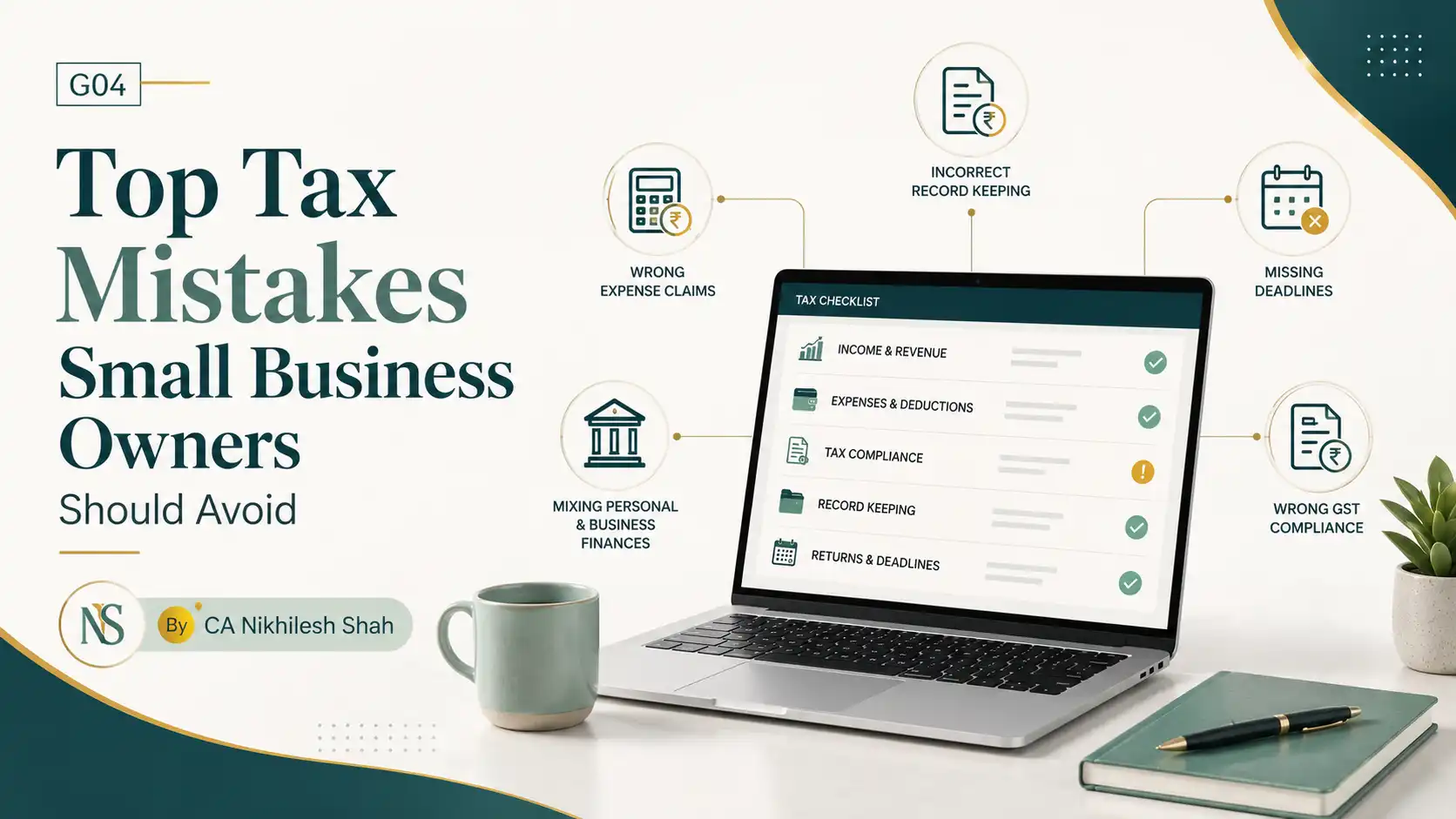
Top Tax Mistakes Small Business Owners Should Avoid
When Vikram started his digital marketing agency three years ago, his focus was simple - find clients, deliver quality work, and grow revenue.
Within a short period, his agency expanded from a one-person operation to a team of twelve employees. Revenue crossed ₹1.2 crore annually, and business appeared to be thriving.
Then one afternoon, he received an email from his accountant.
"We need to discuss a few issues before filing your tax return."
The discussion wasn't about reducing taxes.
Instead, it revolved around:
- Missing invoices
- Delayed GST filings
- Advance tax interest
- Personal expenses booked as business costs
- TDS defaults
None of these mistakes involved tax evasion.
Most resulted from a lack of systems rather than bad intentions.
As Chartered Accountants, we often find that small business owners are excellent at building businesses but underestimate the importance of financial compliance. Many assume taxes can be sorted out at year-end, only to discover that several opportunities have already been lost and avoidable liabilities have accumulated.
Tax compliance is not just about filing returns. It influences profitability, cash flow, business credibility, and even investor confidence.
The following case studies demonstrate how ordinary compliance mistakes can become expensive - and how they can be prevented with better planning.
Case Study One
The Growing Agency That Outgrew Its Accounting System
Vikram's agency began as a freelance consultancy.
Initially, maintaining accounts in a spreadsheet worked perfectly.
However, as business expanded, several new challenges emerged.
Payments were received through:
- Bank transfers
- UPI
- Payment gateways
- International clients
Expenses were incurred through:
- Personal credit cards
- Business bank accounts
- Cash reimbursements
Invoices were raised manually.
Some clients deducted TDS.
Others didn't.
Several overseas clients paid in foreign currency.
Despite the increasing complexity, Vikram continued using the same basic accounting system.
At year-end, we discovered several issues:
- Business income reported by clients under TDS did not match his books.
- Some invoices had never been recorded.
- Personal travel expenses had been claimed as business expenditure.
- Advance tax had not been paid.
- GST reconciliation revealed differences between invoices and returns.
The business itself was profitable.
The accounting system was not.
What Went Wrong
None of Vikram's problems arose because he deliberately ignored tax laws.
The problems developed because the business grew faster than its compliance processes.
Some common mistakes included:
Delaying Bookkeeping
Recording transactions months later increased the chances of missing receipts and invoices.
Ignoring Advance Tax
Many entrepreneurs assume taxes become payable only after preparing annual accounts.
In reality, businesses with tax liability above the prescribed threshold generally need to pay advance tax during the financial year. Delays may attract interest under Sections 234B and 234C of the Income-tax Act.
Poor Expense Documentation
Several expenses lacked proper invoices.
Even genuine business expenses become difficult to support without documentary evidence.
Mixing Personal and Business Transactions
Personal holidays, family shopping, and household expenses had been paid from the business account.
This complicated bookkeeping and weakened tax positions.
No Monthly Reconciliation
Books were never reconciled with:
- Bank statements
- GST returns
- Form 26AS
- Annual Information Statement (AIS)
Small differences accumulated into significant reporting mismatches.
Understanding the Tax Position
Small businesses often focus on tax liability while overlooking compliance.
From a practical perspective, good tax management rests on five pillars.
Maintain Accurate Books of Account
Books should reflect every business transaction accurately and on time.
Accounting is not merely a compliance requirement - it supports decision-making, budgeting, and financial planning.
Separate Business and Personal Finances
Every business should operate through dedicated bank accounts.
Personal expenses should never be booked as business expenditure unless genuinely related to business operations.
This improves transparency and simplifies tax assessments.
Pay Advance Tax on Time
Businesses should estimate taxable income periodically and review advance tax obligations before each due date.
This reduces interest costs and improves cash flow planning.
Review GST and Income Tax Together
Many notices arise because turnover reported under GST differs from turnover declared in the Income Tax Return.
Although differences may sometimes be justified, they should always be reconciled and documented.
Preserve Supporting Documents
Maintain:
- Tax invoices
- Purchase bills
- Vendor agreements
- Bank statements
- Loan documents
- TDS certificates
- GST records
- Expense approvals
Documentation remains one of the strongest safeguards during any assessment.
Case Study Two
The Manufacturing Business That Ignored Vendor Compliance
Priya owned a small manufacturing unit supplying packaging material to large companies.
Her turnover was growing steadily.
She believed that because she had hired an accountant, tax compliance was fully under control.
During an annual review, several issues surfaced.
Certain vendors had not issued proper GST invoices.
Some payments requiring tax deduction at source (TDS) had been made without deducting tax.
Large machinery purchases lacked complete supporting records.
In addition, depreciation had been claimed without maintaining adequate documentation regarding installation and business use.
None of these issues appeared significant individually.
Together, however, they exposed the business to:
- Interest liability
- Disallowance of certain expenses
- Vendor disputes
- Delays in assessments
- Increased compliance costs
After implementing stronger internal controls, the business adopted:
- Monthly compliance reviews
- Vendor verification procedures
- Automated accounting software
- Digital document management
- Quarterly tax planning meetings
Within a year, compliance became significantly stronger, and management could focus more on business growth instead of responding to avoidable tax issues.
Lessons Every Business Owner Should Learn
The experiences of Vikram and Priya highlight lessons that apply to businesses across industries.
Business growth should be accompanied by stronger financial systems.
As turnover increases, accounting processes must evolve accordingly.
Do not wait until year-end to review taxes.
Quarterly tax planning identifies problems before they become expensive.
Documentation is as important as payment.
A legitimate expense without supporting evidence may still create difficulties during scrutiny.
Technology improves compliance.
Modern accounting software, automated reconciliations, and cloud-based record management significantly reduce errors.
Monitor vendor compliance.
Your compliance can also be affected by documentation received from suppliers.
Review financial information regularly.
Reconciling books with GST returns, Form 26AS, AIS, and bank records reduces reporting mismatches.
Professional advice should be preventive, not corrective.
Consulting a Chartered Accountant before major transactions often saves considerably more than addressing issues after they arise.
Practical Recommendations
Based on years of advising growing businesses, I recommend the following practical measures:
- Maintain books of account throughout the year rather than updating them at the last minute.
- Use separate bank accounts for business and personal transactions.
- Estimate tax liability every quarter.
- Pay advance tax within the prescribed timelines.
- Conduct monthly GST and accounting reconciliations.
- Preserve invoices and supporting documents digitally.
- Review vendor invoices before making payments.
- Reconcile Form 26AS and AIS before filing Income Tax Returns.
- Train employees handling finance on basic tax compliance.
- Schedule an annual tax health check with your Chartered Accountant.
Strong compliance systems reduce financial risk while improving operational efficiency.
Compliance Checklist
Before closing every financial year, ensure the following:
✔ Maintain updated books of account.
✔ Separate business and personal expenses.
✔ Preserve invoices and payment records.
✔ Verify GST returns with accounting records.
✔ Reconcile Form 26AS and AIS.
✔ Pay advance tax on time.
✔ Verify TDS deductions and credits.
✔ Maintain asset purchase documentation.
✔ Review vendor compliance.
✔ Retain contracts and business agreements.
✔ Conduct an annual tax review with a Chartered Accountant.
Final Takeaway
The most costly tax mistakes are rarely the result of deliberate non-compliance.
More often, they arise from delayed bookkeeping, inadequate documentation, poor planning, and the misconception that tax compliance is only an annual exercise.
As businesses grow, financial processes must mature alongside operations. Accurate accounting, timely reconciliations, disciplined record-keeping, and proactive tax planning are not merely compliance obligations - they are essential tools for sustainable growth.
Small businesses that invest in strong compliance systems enjoy several long-term advantages: improved cash flow management, greater credibility with banks and investors, reduced litigation risk, and better strategic decision-making.
Rather than viewing taxation as a year-end burden, business owners should integrate tax planning into their regular management process. With timely professional guidance and robust internal controls, tax compliance becomes a competitive advantage rather than a challenge.