

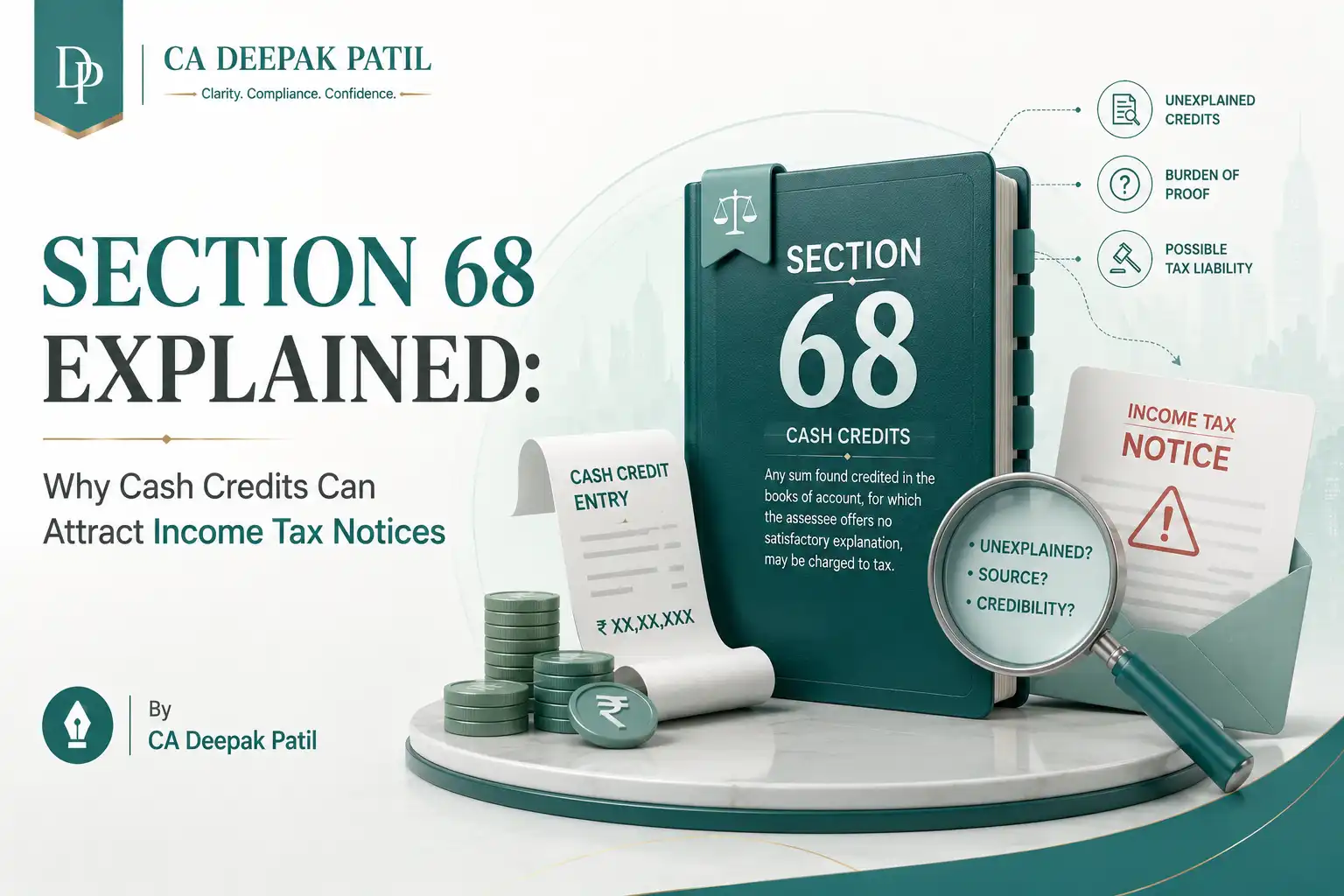
Many taxpayers believe that any amount credited to their bank account or recorded in their books is acceptable if they know where it came from. However, the Income Tax Department follows a different approach. If you cannot satisfactorily explain the source of a credit appearing in your books of accounts, the amount may be treated as your income under Section 68 of the Income Tax Act, 1961.
Section 68 is one of the most frequently used provisions during income tax assessments. It helps tax authorities identify unexplained money introduced into books through loans, gifts, share capital, business receipts, or other credits that cannot be properly supported with evidence.
Whether you are a salaried employee, small business owner, professional, investor, or first-time taxpayer, understanding Section 68 is essential. A genuine transaction supported by proper documents is usually not a problem. The difficulty begins when records are incomplete or the source of funds cannot be established.
With increasing use of technology, annual information statements, banking data, and digital financial reporting, unexplained cash credits are identified much faster than before. Knowing how Section 68 works can help you avoid unnecessary tax notices and penalties.
What Is Section 68 of the Income Tax Act?
Section 68 of the Income Tax Act, 1961 provides that when any sum is found credited in the books of an assessee during a financial year and the taxpayer either offers no explanation about its nature and source or the explanation is not satisfactory in the opinion of the Assessing Officer, the amount may be treated as income of that financial year.
Simply put, if money appears in your books but you cannot prove where it came from, the Income Tax Department can treat it as taxable income.
The purpose of Section 68 is to prevent taxpayers from introducing unaccounted money into their financial records in the form of loans, gifts, investments, capital contributions, or other transactions.
Why Does Section 68 Matter?
Section 68 has become increasingly important because tax authorities now have access to extensive financial information through various reporting systems.
These include:
- Bank account reporting
- Income Tax Returns
- Annual Information Statement (AIS)
- Statement of Financial Transactions (SFT)
- PAN-based financial reporting
- Digital payment records
When the information reported by different sources does not match your explanation, the department may ask questions regarding the credit.
Ignoring such notices or providing incomplete information can lead to additional tax liability.
What Is Considered a Cash Credit?
Many people assume that Section 68 applies only to cash deposits. This is incorrect.
A cash credit simply means any amount credited in the books of accounts, regardless of whether it is received in cash, cheque, bank transfer, or any other mode.
Common examples include:
Business Loans
A business receives ₹10 lakh as a loan from an individual. If the lender cannot be identified or the source of the lender's funds cannot be proved, the amount may be questioned under Section 68.
Gifts
An individual receives a large gift from a relative or friend and records it in the books. If supporting documents are missing or the donor cannot establish financial capacity, the department may investigate the transaction.
Share Capital
Private companies often receive investments from shareholders. If investors are not genuine or their financial capacity cannot be demonstrated, Section 68 may be invoked.
Capital Introduced by Proprietors
Business owners sometimes introduce capital into their businesses. The tax department may seek evidence showing how the funds were generated.
Unexplained Credits
Any credit entry without proper supporting documents may attract scrutiny.
The Three Important Conditions Every Taxpayer Must Prove
One of the most important aspects of Section 68 is that the taxpayer generally needs to establish three key factors.
Identity of the Person
The taxpayer should establish who provided the money.
Useful documents include:
- PAN
- Aadhaar
- Passport
- Company registration documents
- Address proof
The department must be able to identify the person or entity involved.
Creditworthiness
It is not enough to identify the person.
The taxpayer should also demonstrate that the person had sufficient financial capacity to provide the money.
Evidence may include:
- Income Tax Returns
- Bank statements
- Salary records
- Audited financial statements
- Capital account
- Net worth details
If someone earning a modest income claims to have advanced a very large loan, the department may question the transaction.
Genuineness of the Transaction
The transaction itself should be genuine.
Documents that help establish genuineness include:
- Loan agreements
- Gift deeds
- Bank transfer records
- Interest payment records
- Board resolutions where applicable
- Proper accounting entries
A transaction supported only by verbal statements is usually insufficient during assessment proceedings.
Practical Example
Suppose Raj owns a small trading business.
He records a credit of ₹15 lakh as an unsecured loan received from a friend.
During assessment, the Assessing Officer asks for supporting documents.
Raj submits only the friend's name and mobile number.
He cannot provide:
- PAN of the lender
- Bank statement
- Income proof
- Loan agreement
- Source of funds
Although Raj insists that the money is genuine, he is unable to establish the lender's identity, creditworthiness, and the genuineness of the transaction.
In such a situation, the Assessing Officer may invoke Section 68 and treat the ₹15 lakh as unexplained income, subject to applicable tax provisions.
Who Can Receive a Notice Under Section 68?
Many people believe that only large businesses receive notices. That is not true.
Section 68 can apply to different categories of taxpayers depending on the nature of the transaction.
It may affect:
- Salaried employees receiving large unexplained credits.
- Small business owners recording unsecured loans.
- Professionals introducing capital into their practice.
- Private companies receiving share capital or share premium.
- Partnership firms recording partner contributions.
- Individuals claiming gifts without adequate evidence.
- Property buyers explaining the source of investment during assessment.
The amount involved does not always determine whether scrutiny will happen. Even comparatively smaller credits can be examined if the explanation is inconsistent, documentation is weak, or the transaction appears unusual when compared with the taxpayer's financial profile.
When Is Section 68 Commonly Invoked?
The Income Tax Department may examine cash credits during scrutiny assessments, reassessment proceedings, or verification of information received through financial reporting systems. Certain situations are more likely to attract attention.
These include:
- Large unsecured loans without proper documentation.
- Cash deposits that do not match reported income.
- Share capital received from doubtful investors.
- Gifts from persons whose financial capacity is uncertain.
- Capital introduced without evidence of the source.
- Credits recorded shortly before the end of the financial year.
- Transactions that differ from information available in the Annual Information Statement or bank records.
Proper documentation at the time of the transaction can significantly reduce future disputes.
Tax Consequences of Unexplained Cash Credits
If the Assessing Officer is not satisfied with the explanation provided, the amount may be treated as income under Section 68.
Such additions can result in:
- Higher taxable income.
- Tax at the rate prescribed under applicable provisions of the Income Tax Act.
- Interest for delayed payment of tax under relevant sections.
- Penalty proceedings wherever applicable under the law.
- Extended assessment and litigation.
Apart from the financial impact, taxpayers may spend considerable time responding to notices and producing supporting evidence.
Important Legal Position
Section 68 places an initial responsibility on the taxpayer to explain the nature and source of the credit appearing in the books.
Courts have repeatedly observed that merely giving the name of a person is not enough. The taxpayer should normally establish identity, creditworthiness, and genuineness using reliable documentary evidence.
Once sufficient evidence is produced, the burden may shift to the tax department to examine the material further. Therefore, maintaining complete records is always advisable.
Common Mistakes Taxpayers Make
Many additions under Section 68 occur because taxpayers fail to preserve documents rather than because the transaction is actually false.
Some common mistakes include:
- Accepting loans without written agreements.
- Receiving money from persons who cannot explain their own source of funds.
- Depending only on cash transactions.
- Failing to keep bank statements and confirmations.
- Recording gifts without proper gift deeds.
- Ignoring notices issued by the Income Tax Department.
- Assuming family transactions never require documentation.
- Introducing business capital without maintaining evidence of accumulated savings.
Avoiding these mistakes can make assessment proceedings much smoother.
Practical Tips to Stay Compliant
Good financial discipline is the best defence against Section 68 disputes.
Follow these practical steps:
- Use banking channels for significant transactions.
- Collect PAN and identity documents from lenders or donors.
- Keep signed confirmations for loans and gifts.
- Preserve bank statements showing the movement of funds.
- Maintain agreements and supporting correspondence.
- Ensure entries in books match actual transactions.
- Respond to income tax notices within the prescribed time.
- Consult a Chartered Accountant before entering into high-value financial transactions.
Small efforts today can prevent major tax problems later.
Real Life Scenario
Meera operates a small consultancy firm. She introduces ₹8 lakh into her business from her personal savings accumulated over several years. She maintains salary records, previous bank statements, fixed deposit maturity documents, and withdrawal records.
During assessment, she submits all these documents. Since the source of funds is properly explained and supported by evidence, the Assessing Officer is able to verify the transaction more easily. This example shows that genuine transactions supported by proper records generally face fewer challenges.
Conclusion
Section 68 is an important anti-tax evasion provision that encourages transparency in financial transactions. It does not prevent genuine loans, gifts, investments, or capital contributions. Instead, it requires taxpayers to explain where the money came from and support their explanation with credible evidence.
Whether you are a salaried employee, business owner, investor, or first-time taxpayer, maintaining proper financial records should be a regular habit. Identity proofs, bank statements, tax returns, agreements, and confirmations can make a significant difference during assessment proceedings.
If you receive an income tax notice relating to unexplained cash credits, do not panic or ignore it. Review the transaction carefully, gather supporting documents, and seek professional guidance wherever required. Timely compliance and accurate documentation are the best ways to avoid unnecessary tax additions and prolonged litigation.