
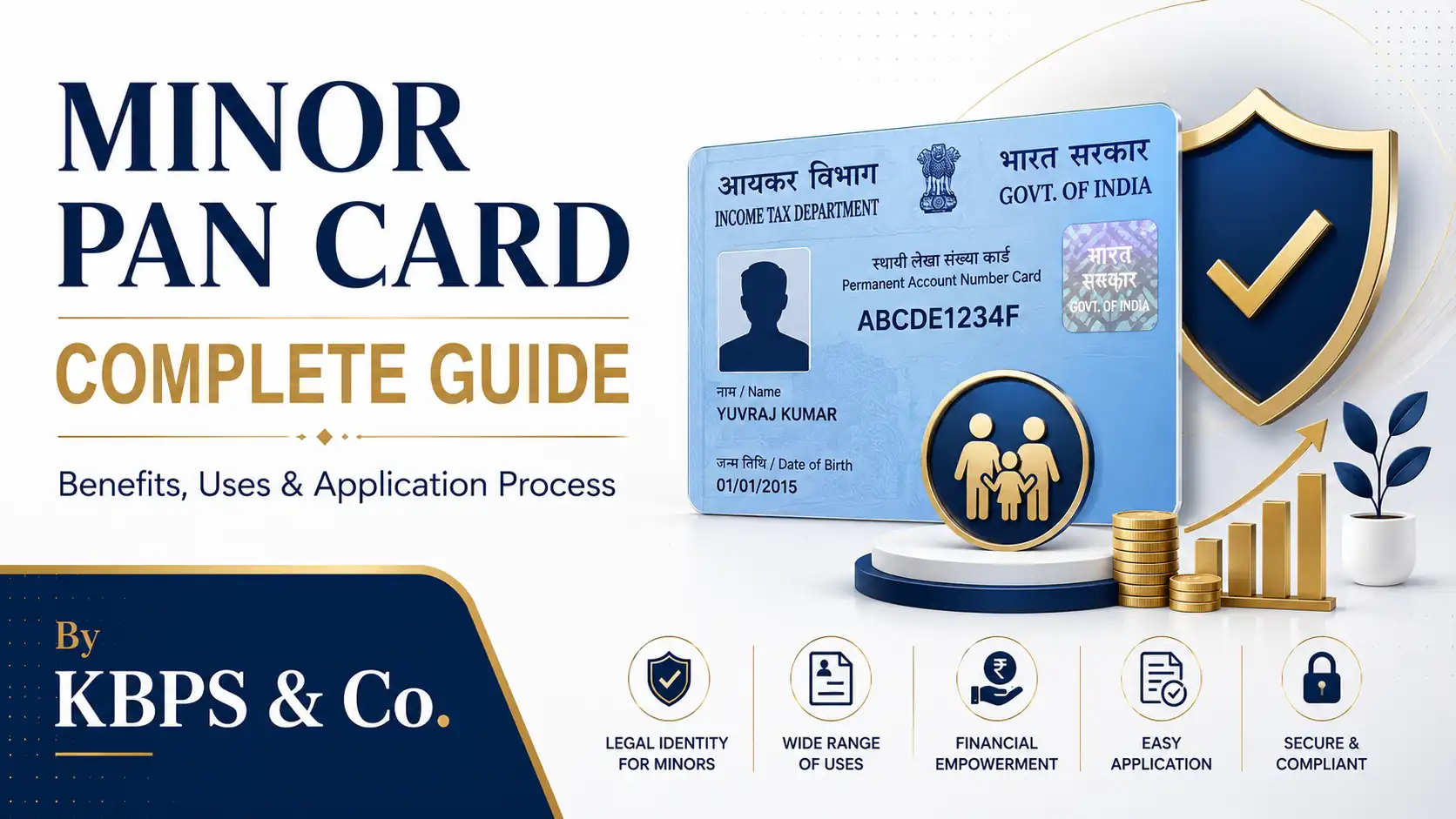
The Minor PAN Card: A Comprehensive Guide
Featured Snippet: What Is a Minor PAN Card?
A Minor PAN Card is a Permanent Account Number (PAN) issued by the Income Tax Department of India to individuals below 18 years of age. It helps parents invest in the child’s name, open bank accounts, become a nominee in financial products, and comply with tax regulations. While a minor cannot independently conduct most financial transactions, obtaining a PAN card early simplifies future financial and tax-related activities.
The Minor PAN Card: Why It Matters More Than Ever in 2026
In an era where financial literacy starts early and parents actively invest for their children's future, the demand for Minor PAN Cards has increased significantly. Whether it is opening a bank account, investing in mutual funds, purchasing government bonds, or creating long-term wealth plans, a PAN card for minors has become an essential financial identity document.
Many parents assume PAN cards are only necessary once a child starts earning. However, the reality is quite different. A Minor PAN Card can play a crucial role in managing investments, tax compliance, and financial planning from a very young age.
This guide explains everything parents need to know about obtaining and using a Minor PAN Card in 2026.
Understanding the Current Landscape
India's financial ecosystem has become increasingly digital and compliance-driven. Financial institutions now require proper identification and KYC documentation for nearly every investment and banking activity.
As families focus more on:
- Child education funds
- Long-term wealth creation
- Mutual fund investments
- Sukanya Samriddhi Accounts
- Family business succession planning
having a PAN card for a minor is becoming a practical necessity rather than an optional document.
Key Statistics
- Millions of investment accounts in India are now opened for minors annually.
- PAN has become one of the primary identity documents for KYC verification.
- Digital investment platforms increasingly require PAN-based authentication.
- Financial regulators continue strengthening transparency through PAN-linked transactions.
What Is a Minor PAN Card?
A Minor PAN Card is identical to a regular PAN card in terms of the 10-character alphanumeric PAN number.
The primary difference is that it is issued to an individual below 18 years of age and is generally managed by the parent or legal guardian until the child reaches adulthood.
Key Features
| FeatureMinor PAN Card | |
| Available for children below 18 | Yes |
| Unique PAN Number | Yes |
| Tax Identification | Yes |
| Guardian Representation | Required |
| Can Hold Investments | Yes |
| Can Be Updated at 18 | Yes |
Why Should Parents Apply for a Minor PAN Card?
Many parents only realize the importance of a PAN card when an investment or banking requirement arises.
A Minor PAN Card can be useful for:
Opening Bank Accounts
Several banks offer minor savings accounts that may require PAN documentation depending on transaction levels and account features.
Investing in the Child's Name
PAN is often required for:
- Mutual Funds
- Stocks
- Bonds
- Government securities
- Child investment plans
Acting as a Nominee
Financial institutions may require PAN details when a child is designated as a nominee.
Tax Compliance
Although a minor generally does not file taxes independently, PAN helps maintain proper records where income or investments exist.
Core Concepts Every Parent Should Know
Is PAN Mandatory for Every Minor?
No.
A PAN card is not compulsory for every child. However, it becomes beneficial when financial transactions or investments are involved.
Can a Minor Earn Taxable Income?
In certain situations, yes.
Examples include:
- Child artists
- Sports professionals
- Child influencers
- Inherited assets generating income
- Investments made in the child's name
Who Controls the PAN?
The parent or legal guardian manages the PAN-related activities until the child becomes a major.
Key Challenges Families Face
Despite its benefits, many families encounter challenges while obtaining a Minor PAN Card.
Documentation Issues
Parents often struggle with:
- Proof of age
- Birth certificate requirements
- Guardian documentation
- Address proof inconsistencies
KYC Mismatches
Incorrect spelling or mismatched details can delay processing.
Lack of Awareness
Many parents are unaware that children can legally possess a PAN card.
Update Requirements at Age 18
Once the child becomes an adult, PAN records must be updated with:
- Signature
- Photograph
- Adult KYC documents
Emerging Trends in 2026
The role of Minor PAN Cards is evolving alongside India's digital financial ecosystem.
Digital-First Investing
Parents increasingly invest online for children's future goals.
Early Financial Planning
Families are starting wealth creation plans much earlier than previous generations.
Fintech Integration
Investment platforms now offer dedicated child-focused investment products requiring PAN-based KYC.
Enhanced Compliance
Regulators continue promoting transparency through PAN-linked financial reporting.
Expert Insight
Forward-thinking families no longer view a PAN card merely as a tax document. Instead, they see it as a foundational financial identity that supports future investments, education planning, and wealth management.
Parents who establish financial records early often experience smoother transitions when children become financially independent adults.
How to Apply for a Minor PAN Card
Step 1: Gather Required Documents
Documents generally include:
- Birth Certificate of the child
- Parent's PAN Card
- Parent's Aadhaar Card
- Address Proof
- Passport-size photographs (if required)
Step 2: Submit Application
Applications can be submitted through authorized PAN service providers.
Step 3: Verification
The details are verified by the issuing authority.
Step 4: PAN Allotment
After approval, the PAN number is generated and issued.
Pro Tip
Before submitting the application, ensure that the child's name matches exactly across all documents. Even minor spelling differences can create future KYC complications.
Practical Example
Case Study: Planning for Higher Education
Mr. Sharma begins investing ₹10,000 monthly in mutual funds for his 5-year-old daughter.
To complete KYC and maintain investments in the child's name, he applies for a Minor PAN Card.
Benefits achieved:
- Dedicated investment portfolio
- Proper financial documentation
- Easier tracking of education corpus
- Smooth future transition when the child turns 18
This simple step creates a structured financial roadmap for the child's future.
Common Misconceptions About Minor PAN Cards
Myth 1: PAN Is Only Needed After Age 18
Reality: Minors can legally obtain PAN cards and use them for financial activities.
Myth 2: Minors Cannot Hold Investments
Reality: Investments can be held in a minor's name under guardian supervision.
Myth 3: Minor PAN Automatically Updates at 18
Reality: The PAN remains valid, but details such as photograph and signature must be updated.
Myth 4: PAN Means the Child Must File Tax Returns
Reality: Having a PAN card does not automatically create a tax filing obligation.
Action Plan for Parents
If you're considering a Minor PAN Card, follow this framework:
Immediate Actions
✓ Assess whether your child has investments or bank accounts
✓ Gather age and identity documents
✓ Verify guardian documents
Medium-Term Actions
✓ Link investments correctly
✓ Maintain accurate KYC records
✓ Keep PAN information updated
Long-Term Actions
✓ Update PAN details once the child turns 18
✓ Transition investment control smoothly
✓ Incorporate PAN into broader financial planning
Future Outlook
As India's financial ecosystem becomes increasingly digitized, the importance of Minor PAN Cards is expected to grow.
Over the next few years:
- More child-focused investment products will emerge.
- Digital KYC requirements will expand.
- Financial institutions will rely more heavily on PAN-linked verification.
- Parents will adopt earlier wealth-planning strategies for children.
A Minor PAN Card will likely become a standard component of long-term family financial planning.
Conclusion
A Minor PAN Card is much more than a tax identification number. It serves as a foundational financial identity that enables investments, simplifies compliance, and supports long-term wealth creation for children.
For parents focused on education planning, investment growth, and financial security, obtaining a Minor PAN Card early can provide significant advantages. As financial systems become increasingly digital and compliance-oriented, having this document in place ensures smoother access to opportunities and fewer administrative hurdles in the future.
FAQs
1. Can a newborn baby get a PAN card?
Yes. There is no minimum age requirement for obtaining a PAN card in India. Parents or legal guardians can apply on behalf of a newborn child using the birth certificate and relevant guardian documents. The PAN remains valid throughout the child's lifetime.
2. Is Aadhaar mandatory for a Minor PAN Card?
The requirements may vary depending on the application process and applicable regulations. Generally, proof of identity, age, and guardian documentation are required. Aadhaar is often used as a supporting document where available.
3. Can a minor file an income tax return?
Yes, under certain circumstances. If the minor earns income independently, such as through professional activities, inheritance, or specific investments, tax obligations may arise. Professional tax advice should be obtained in such situations.
4. What happens to the PAN card when the child turns 18?
The PAN number remains unchanged. However, the individual should update the PAN records with a recent photograph, signature, and adult KYC documents to reflect major status.
5. Can mutual funds be purchased using a Minor PAN Card?
Yes. Mutual fund investments can be made in the name of a minor under the supervision of a parent or legal guardian. PAN-based KYC requirements generally apply before investments can be processed.