

I booked a flat in 2019. Got possession in 2022. The conveyance deed was registered in 2024. Now I want to sell it in 2025. Is my gain long-term or short-term? Which date do I count from 2019, 2022, or 2024?"
This is one of the most genuinely contested questions in property capital gains and it has significant tax consequences. The difference between long-term and short-term capital gains on property can easily be several lakhs of rupees in tax. And when LTCG STCG property allotment possession conveyance all happen in different years as they often do with under-construction flats and builder projects the question of which date starts the holding period clock becomes critical.
The Income Tax Act does not give a single clean answer. Courts and tribunals have had to fill the gap. This blog explains the legal position as it stands, what the dominant view is, and how to protect your tax filing position.
Why LTCG STCG Property Allotment Possession Conveyance Creates Tax Confusion
For most property transactions, the purchase date and the ownership date are the same you buy a ready flat, register it, take keys, and the date is clear. But in India, the majority of residential property transactions involve under-construction properties where the journey from booking to legal ownership spans multiple years.
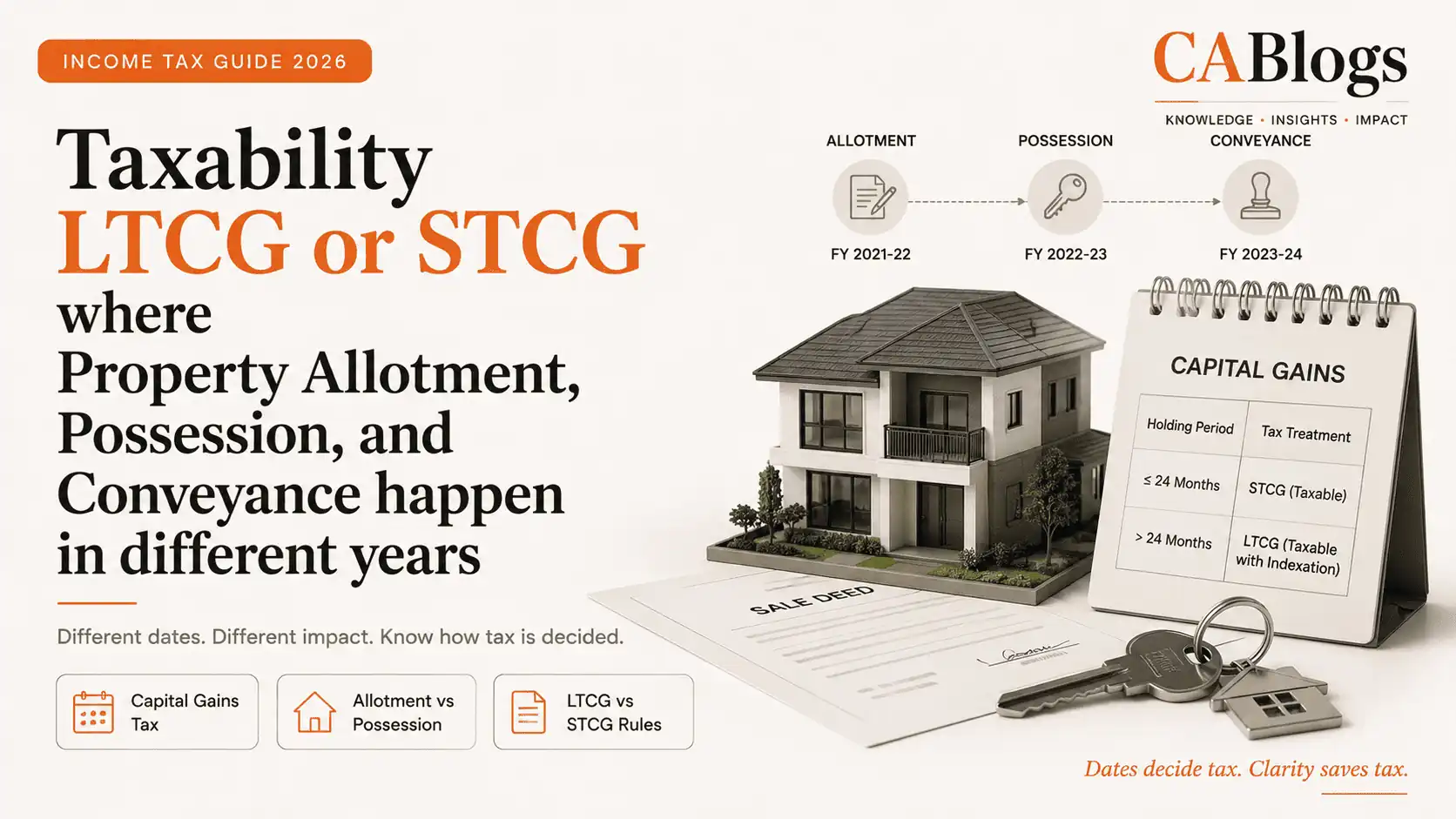
A typical under-construction property transaction involves three distinct events spread across time:
Allotment Letter - The builder issues a formal allotment letter confirming the flat is booked in your name. Payment schedule begins. This is often the first legal document establishing your interest in the property.
Possession - Construction completes, the builder hands over physical possession of the flat. You receive the keys. A possession letter is issued. At this point you can occupy the property but legal title may not yet be transferred.
Conveyance Deed / Sale Deed Registration - The formal sale deed is executed and registered at the Sub-Registrar office. Legal title passes to you. This is the document that conclusively establishes ownership in the eyes of property law.
Each of these three events can be separated by one, two, three or even more years. When you subsequently sell the property, the holding period - and therefore whether your gain is LTCG or STCG - depends entirely on which of these three dates you count from.
What the Income Tax Act Says About the Holding Period
Under Section 2(42A) of the Income Tax Act, the holding period of an immovable property is counted from the date of acquisition. For property to qualify as a long-term capital asset, it must be held for more than 24 months.
The Act does not specifically define "date of acquisition" for under-construction properties. It does not say whether allotment, possession, or registration is the trigger. This statutory gap is the source of all the controversy around LTCG STCG property allotment possession conveyance timing.
The Three Positions and What Each Means
Position 1 - Date of Allotment
This is the taxpayer-friendly position and the one most consistently upheld by the Income Tax Appellate Tribunal (ITAT) across multiple benches. The argument is that the allotment letter creates a legally enforceable right in the property the buyer has paid substantial consideration, the builder has agreed to transfer a specific unit, and the interest in the asset has been acquired even though physical possession and registration follow later.
Multiple ITAT decisions have held that the date of allotment should be treated as the date of acquisition for the purpose of computing the holding period. If you received your allotment letter in 2019 and sold the property in 2025 after taking possession in 2022 and registering in 2024 your holding period is 6 years from 2019 and the gain is unambiguously long-term.
Position 2 - Date of Possession
Some assessments and a minority of court decisions have taken the view that possession the actual physical handing over of the property is the date of acquisition. The reasoning is that before possession, the buyer has a contractual right but not actual ownership or control of the asset.
This position is less consistently upheld but does surface in assessments, especially where the allotment letter is not a formal registered document.
Position 3 - Date of Registration
The Income Tax Department has in many cases argued that only the date of the registered sale deed - the conveyance deed constitutes acquisition, because legal title only passes on registration under the Transfer of Property Act and the Registration Act.
This is the most conservative and tax-unfavourable position for the taxpayer. If registration happened in 2024 and sale is in 2025, the holding period is only one year making the gain short-term and taxable at slab rate instead of 12.5%.
The dominant judicial position as of 2026: Multiple High Courts and ITAT benches have consistently held that the date of allotment is the most appropriate date of acquisition for under-construction properties where a formal allotment letter exists, substantial payments have been made, and the buyer has a legally enforceable right. The Supreme Court has not issued a definitive ruling on this specific question but the weight of authority favours the allotment date. Filing with allotment date as acquisition date with a strong paper trail is the most defensible position for most taxpayers.
How the Cost of Acquisition Is Computed Across the Three Events
The holding period question and the cost question are separate. Even if the date of allotment is accepted as acquisition date, the total cost of acquisition includes all payments made to the builder across the entire construction period booking amount, instalment payments, GST paid, stamp duty and registration charges at the time of registration, and any other charges forming part of the purchase consideration.
All of these amounts are part of your cost regardless of which year they were paid. The capital gain is the sale price minus this total accumulated cost. The holding period determines whether that gain is LTCG or STCG.
Real Situation
Deepa booked an under-construction flat in Pune in August 2019. Allotment letter received in September 2019. She paid instalments through 2019 to 2022 totalling Rs 85 lakhs including GST and registration charges. Possession was handed over in March 2022. The sale deed was registered in January 2023. She sold the flat in October 2025 for Rs 1.25 crore. Total holding from allotment date: over 6 years. Gain of Rs 40 lakhs is clearly long-term at 12.5% tax of Rs 5 lakhs. If the department argued registration date as acquisition date, holding period would be about 2 years and 9 months still long-term as it exceeds 24 months. But if possession date were the trigger, holding period from March 2022 to October 2025 is 3.5 years also long-term. In Deepa's case all three dates result in LTCG. The real risk is for someone who sells within 24 months of possession or registration but more than 24 months after allotment.
When the LTCG STCG Property Allotment Possession Conveyance Gap Creates the Biggest Risk
The tax risk is most acute in one specific scenario: when the taxpayer sells the property more than 24 months after allotment but less than 24 months after possession or registration. In this situation:
- Using allotment date the gain is long-term at 12.5%
- Using possession or registration date the gain is short-term at slab rate which could be 30% plus surcharge
The difference in tax can be enormous. On a gain of Rs 50 lakhs, the difference between 12.5% and 30% is Rs 8.75 lakhs in additional tax purely based on which date is accepted as the acquisition date.
What to do before selling: If you are in this grey zone more than 24 months from allotment but less than 24 months from possession or registration do not file your ITR using allotment date without a formal CA opinion documenting your legal basis. If the department challenges the date and you have no documented reasoning, the reassessment penalty on top of the additional tax can be severe. A written opinion protects your filing position.
Section 54 and 54F Exemptions Do They Still Apply
If the gain qualifies as long-term based on allotment date, the exemptions under Section 54 (reinvestment in another residential house) and Section 54F (reinvestment from non-residential asset) are available as they would be for any LTCG on property. The allotment date position does not affect eligibility for these exemptions it only determines whether the gain is long-term in the first place.
If the gain turns out to be short-term because holding period from any date is under 24 months, neither Section 54 nor Section 54F applies both are available only for long-term capital assets.
Documentation to keep for every under-construction property: Allotment letter with date, all payment receipts with dates and amounts, possession letter with date, registered sale deed with registration date, and builder correspondence confirming the unit. This complete paper trail supports the allotment date filing position and makes the holding period calculation unambiguous when you eventually sell.
Frequently Asked Questions
Which date counts as the date of acquisition for LTCG STCG property allotment possession conveyance in different years?
The dominant judicial position upheld by multiple ITAT benches is that the allotment date is the date of acquisition for under-construction properties where a formal allotment letter exists and substantial consideration has been paid. This gives the taxpayer the longest holding period and the most favourable LTCG classification. However the Income Tax Department may contest this and argue for possession or registration date, making documentation and a formal CA opinion essential.
How long must I hold a property to qualify for LTCG treatment in India?
Immovable property must be held for more than 24 months to qualify as a long-term capital asset under Section 2(42A). If held for 24 months or less, the gain is short-term and taxed at the individual's applicable slab rate. If held for more than 24 months, long-term capital gains are taxed at 12.5% without indexation as per Finance Act 2024 amendments.
What is included in the cost of acquisition for an under-construction flat?
The total cost of acquisition includes all payments made to the builder booking amount, construction-linked instalments, GST paid, stamp duty, registration charges, and any other amounts forming part of the purchase consideration paid across all years from booking to registration. All of these amounts are aggregated as the cost regardless of which year they were individually paid.
Can I claim Section 54 exemption on gains from an under-construction flat sold after allotment?
Yes, provided the gain qualifies as long-term capital gains which requires the holding period from the accepted date of acquisition to exceed 24 months. Section 54 is available for LTCG on sale of a residential house where the proceeds are reinvested in another residential house within the prescribed timeframes. If the gain is short-term, Section 54 is not available.
What happens if the Income Tax Department disputes my allotment date as acquisition date?
If the department disputes the allotment date during assessment and argues for possession or registration date instead, the difference in tax treatment can be significant especially if the shorter period changes the classification from LTCG to STCG. Having a formal CA opinion filed with your return, supported by the allotment letter, payment receipts, and relevant ITAT rulings, significantly strengthens your position in such a dispute and reduces the risk of penalties on the differential tax.
Does the conveyance deed date always determine the holding period for capital gains?
No. While the conveyance deed date is the date legal title formally transfers under property law, multiple ITAT decisions have held that the capital gains holding period for income tax purposes can begin from the allotment date where the buyer has a legally enforceable right in the property and has made substantial payment. The income tax concept of acquisition is broader than the property law concept of title transfer.