

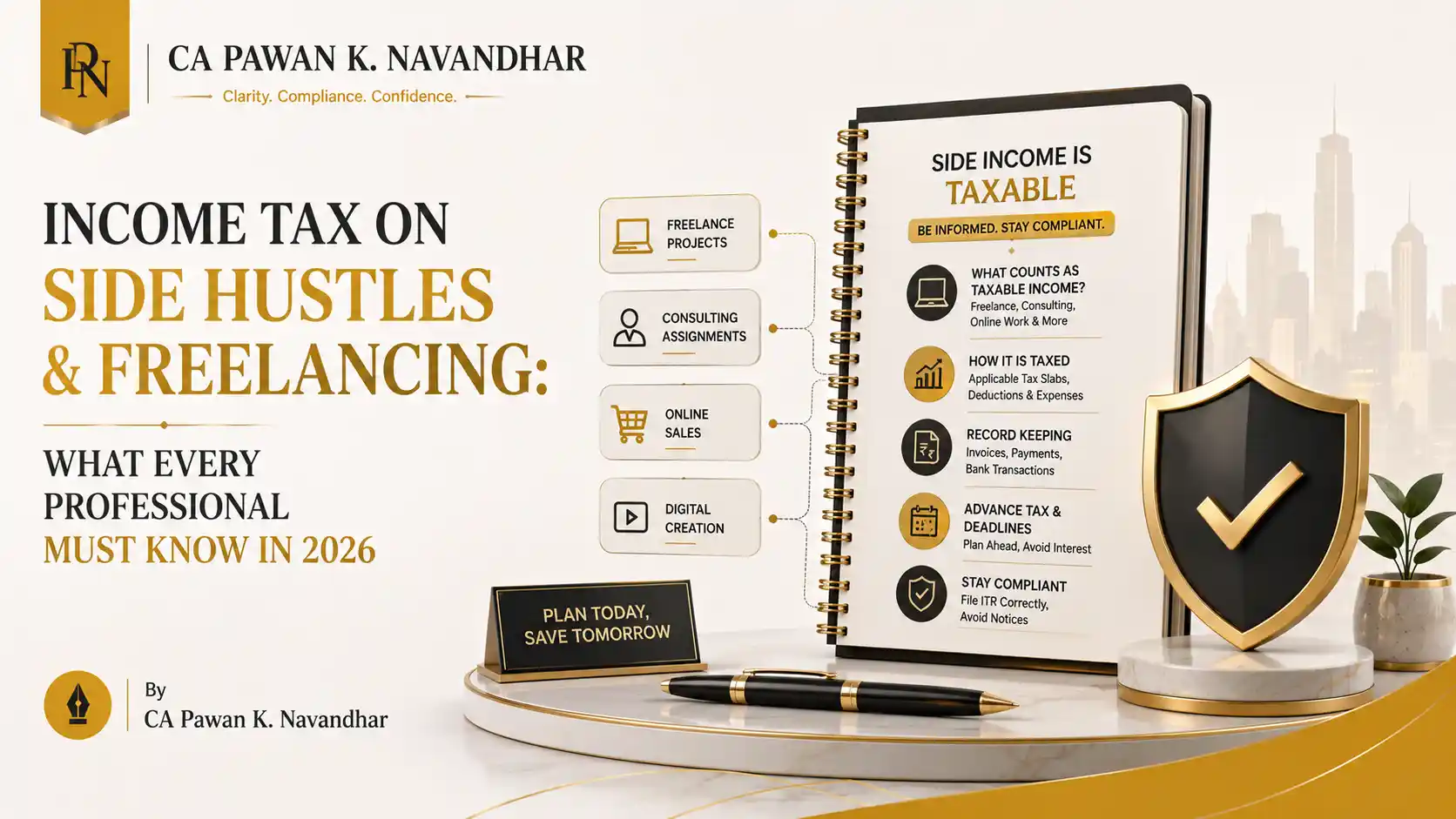
The Indian workforce has changed dramatically over the last few years. Salaried professionals are increasingly earning through consulting assignments, content creation, software development, online coaching, affiliate marketing, investing in digital products, and independent freelancing. What began as supplementary income has become a significant source of earnings for many professionals.
While earning additional income improves financial security, it also introduces important tax responsibilities. The Income Tax Act does not distinguish between a full-time business and a side hustle merely because it generates part-time income. Every rupee earned through freelancing or independent professional activities must be evaluated under the appropriate provisions of the law.
Understanding the taxation framework is not merely about avoiding penalties. Proper compliance helps taxpayers claim legitimate deductions, choose the right taxation scheme, maintain credibility with financial institutions, and build a sustainable business. In 2026, with increased digital payment reporting and stronger data analytics used by the Income Tax Department, voluntary compliance has become more important than ever.
Understanding What Qualifies as a Side Hustle
A side hustle refers to any income-generating activity carried out alongside regular employment or another primary occupation. It may involve providing professional services, selling products, creating digital content, operating an online business, or earning through specialized skills.
Common examples include freelance graphic design, software development, digital marketing consulting, legal drafting, photography, blogging, YouTube monetisation, online tutoring, architecture, technical consulting, and social media management.
The tax treatment depends on the nature of the activity rather than the terminology used by the taxpayer.
Which Head of Income Applies?
One of the most common mistakes professionals make is assuming that freelance income should be reported under "Income from Other Sources."
In most situations, recurring freelance or consulting income is taxable under Profits and Gains of Business or Profession under the Income Tax Act.
Only occasional receipts that do not constitute a systematic commercial activity may fall under other heads of income.
Correct classification is important because it determines:
- Deductible expenses
- Books of account requirements
- Audit applicability
- Presumptive taxation eligibility
- Advance tax obligations
Improper classification may invite scrutiny during assessment proceedings.
Why the Government Taxes Side Hustles Like Regular Businesses
The objective of taxation is based on economic activity rather than employment status.
If two individuals earn identical professional income, they should ordinarily be subject to similar tax principles regardless of whether one works independently or alongside salaried employment.
This approach ensures fairness, prevents tax arbitrage, and broadens the tax base. It also discourages taxpayers from restructuring income merely to obtain unintended tax advantages.
Digital payment systems, marketplace reporting, banking data, and information-sharing mechanisms have significantly improved the government's ability to identify undeclared professional income.
Maintaining Proper Books of Account
Sections 44AA and 44AB prescribe record-keeping and audit requirements depending on the nature and scale of professional activities.
Even where detailed books are not legally mandatory, maintaining proper documentation remains a best practice.
Professionals should preserve:
- Client invoices
- Bank statements
- Payment receipts
- Expense bills
- Contracts
- TDS certificates
- GST records where applicable
Well-maintained documentation supports deductions, simplifies return preparation, and reduces disputes during assessments.
Claiming Business Expenses
A major advantage of reporting freelance income under business or professional income is the ability to claim legitimate business expenses.
Under Section 37, expenses incurred wholly and exclusively for business purposes are generally allowable unless specifically prohibited.
Examples include:
- Internet charges
- Office rent
- Laptop and computer equipment
- Professional software subscriptions
- Mobile expenses
- Travel for client meetings
- Marketing expenditure
- Professional memberships
- Accounting fees
- Training directly related to professional services
However, personal expenses cannot be claimed merely because they were paid from the same bank account.
Maintaining a clear distinction between business and personal expenditure is essential.
Presumptive Taxation Under Section 44ADA
Many independent professionals benefit from Section 44ADA, which simplifies taxation.
Specified professionals whose gross receipts remain within the prescribed threshold may declare a prescribed percentage of receipts as taxable income without maintaining extensive books of account, subject to applicable conditions.
This scheme significantly reduces compliance costs while offering certainty regarding taxable profits.
However, opting for presumptive taxation should be evaluated carefully. Professionals with genuinely higher business expenses may achieve better tax efficiency through normal computation.
Choosing the appropriate method requires analysing profitability rather than merely seeking lower compliance.
Applicability of Section 44AD
Small businesses engaged in eligible business activities may consider Section 44AD where applicable.
However, many professional services are specifically governed by Section 44ADA rather than Section 44AD.
Confusing these provisions is a frequent compliance error and may lead to incorrect tax reporting.
Professional advice is advisable before selecting any presumptive taxation scheme.
Advance Tax Obligations
Freelancers often overlook advance tax because taxes are not automatically deducted from every payment.
Under Sections 208 and 209, advance tax becomes payable where the estimated tax liability exceeds the prescribed limit after considering available tax credits.
Failure to pay advance tax may result in interest under Sections 234B and 234C.
Professionals should estimate annual income periodically rather than waiting until return filing season.
Quarterly tax planning improves cash flow management and prevents year-end financial pressure.
Understanding TDS on Professional Receipts
Clients frequently deduct tax before making payments for professional services.
The deducted amount appears in Form 26AS and the Annual Information Statement (AIS).
Professionals should reconcile client deductions before filing their income tax returns.
Ignoring TDS reconciliation may result in credit mismatches and delayed refunds.
Where tax has been deducted, it represents advance payment of tax rather than an additional tax burden.
GST Considerations for Freelancers
Income tax and GST operate independently.
Many freelancers mistakenly assume that paying income tax automatically satisfies indirect tax obligations.
GST registration depends upon the nature of services, turnover thresholds, interstate supplies, export provisions, and other statutory conditions under GST law.
Professionals should periodically review GST applicability instead of assuming permanent exemption.
Export of services may involve additional compliance requirements despite zero-rated treatment in many situations.
Recent Compliance Trends in 2026
Tax administration has become increasingly technology-driven.
The Income Tax Department now relies extensively on data integration involving banks, payment gateways, online marketplaces, financial institutions, and information reporting systems.
Professionals receiving regular digital payments should expect greater transparency in tax administration.
The Annual Information Statement continues expanding the range of reported financial transactions, making omission of professional receipts increasingly difficult.
The emphasis in 2026 remains voluntary compliance supported by technology rather than traditional manual scrutiny.
Common Compliance Mistakes
Several recurring errors expose professionals to avoidable tax disputes.
Many individuals fail to disclose cash receipts.
Others mix personal and business banking transactions.
Some claim unsupported personal expenses as business deductions.
Several freelancers ignore advance tax until interest becomes payable.
Others choose presumptive taxation without evaluating eligibility.
Delayed return filing, incomplete expense documentation, incorrect income classification, failure to reconcile AIS and Form 26AS, and ignoring GST implications are equally common mistakes.
These errors are usually preventable through timely professional advice and disciplined record keeping.
Practical Tax Planning Strategies
Good tax planning begins when the financial year starts rather than when return filing approaches.
Maintain a dedicated bank account for professional receipts.
Generate invoices consistently.
Digitally store supporting documents.
Review profitability every quarter.
Estimate tax liability before advance tax due dates.
Claim only genuine business expenses.
Evaluate whether presumptive taxation or regular computation provides better tax efficiency.
Reconcile AIS, Form 26AS, and accounting records before filing the return.
Consult a Chartered Accountant whenever business operations expand into multiple income streams or international assignments.
Proactive compliance reduces litigation risk while improving financial credibility with lenders and investors.
Conclusion
Side hustles and freelancing have become mainstream components of India's modern economy. As earnings grow, tax compliance becomes equally important as client acquisition. The Income Tax Act provides several legitimate benefits for professionals, including business deductions and simplified taxation schemes, but these advantages are available only when income is correctly classified and properly reported.
The real objective of tax compliance is not merely avoiding notices. Accurate reporting creates a transparent financial history, strengthens borrowing capacity, supports future business expansion, and enables professionals to operate confidently within the legal framework. In 2026, informed tax planning remains one of the most valuable investments any independent professional can make.