

Filing your Income Tax Return (ITR) often brings a sense of relief. You finally submit the return, download the acknowledgement, and move on with life. But a few days later, you suddenly realize something isn't right. Maybe you forgot to report interest income from a fixed deposit. Perhaps you entered the wrong bank account number or missed claiming a deduction under Section 80C. Sometimes, taxpayers even discover that they selected the wrong ITR form.
If you have experienced this, you're certainly not alone.
Thousands of taxpayers notice errors after filing their returns every year. The good news is that the Income Tax Act provides mechanisms to correct these mistakes. However, choosing the wrong option can lead to unnecessary taxes, penalties, or even notices from the Income Tax Department.
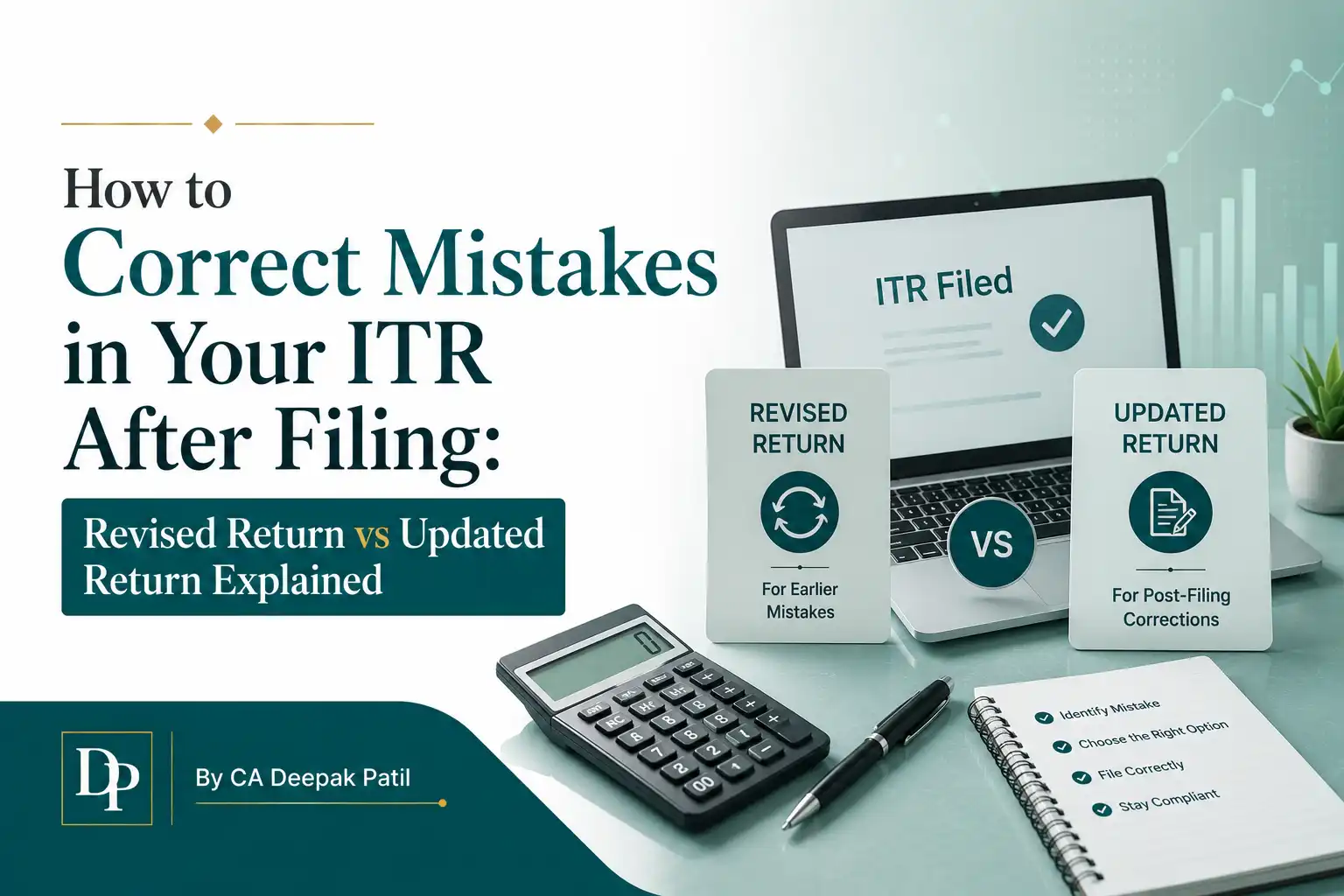
The two most important correction mechanisms are the Revised Return under Section 139(5) and the Updated Return under Section 139(8A). Although both help taxpayers correct mistakes, they serve very different purposes.
Let's understand when each option should be used and how you can avoid costly errors.
Why Correcting an ITR Is Important
Many taxpayers assume that a small mistake doesn't matter. Unfortunately, that's rarely true.
The Income Tax Department now receives information directly from banks, employers, mutual funds, stock exchanges, property registrars, GST records, and various financial institutions. These details are reflected in documents like AIS (Annual Information Statement) and Form 26AS.
If your return does not match the information available with the department, it may trigger scrutiny or notices.
Common mistakes include:
- Forgetting additional sources of income
- Missing TDS details
- Claiming deductions without eligibility
- Selecting the wrong ITR form
- Entering incorrect bank account information
- Reporting incorrect capital gains
- Forgetting foreign income or foreign assets
- Calculation errors while reporting business income
Correcting these mistakes voluntarily is always better than waiting for the department to discover them.
What Is a Revised Return?
A Revised Return is filed under Section 139(5) of the Income Tax Act.
It allows taxpayers to replace their previously filed return with a corrected one if they discover any omission or incorrect information.
Think of it as editing your submission before the assessment process is completed.
When Should You File a Revised Return?
A Revised Return is suitable when:
- You forgot to claim deductions.
- You entered incorrect income figures.
- TDS details were missing.
- You selected the wrong ITR form.
- You reported incorrect bank details.
- You made mathematical mistakes.
- You forgot to include interest income.
For example, suppose Rahul filed his ITR in July. Later, he realized he forgot to claim an additional ₹1.5 lakh deduction under Section 80C because one life insurance premium receipt was misplaced. Since the filing window for revision was still open, he filed a Revised Return and received a higher refund.
Time Limit for Filing a Revised Return
A Revised Return can generally be filed before the prescribed deadline under Section 139(5), which is linked to the relevant assessment timelines, provided the return has not already been completed through assessment where revision is no longer permitted.
It is always advisable to revise your return as soon as the mistake is discovered rather than waiting until the last moment.
What Is an Updated Return?
The Updated Return was introduced through Section 139(8A) to encourage voluntary tax compliance.
Unlike a Revised Return, an Updated Return is mainly intended for taxpayers who failed to disclose income or underreported tax liability.
Instead of waiting for the department to issue notices, taxpayers can voluntarily update their returns and pay the applicable tax along with additional liability.
This provision promotes transparency while reducing prolonged litigation.
When Should You File an Updated Return?
An Updated Return is appropriate when:
- You forgot to report income.
- Additional income is discovered later.
- Business income was understated.
- Rental income was missed.
- Interest income was omitted.
- Capital gains were not reported.
- Foreign income was left out accidentally.
Imagine Priya filed her return showing total income of ₹14 lakh. Six months later, she discovered that interest from multiple fixed deposits worth ₹90,000 had not been included.
Since this omission increased her taxable income, she could file an Updated Return, pay the additional tax and applicable charges, and voluntarily regularize her compliance before departmental action.
When an Updated Return Cannot Be Filed
The law also places certain restrictions on Updated Returns.
Generally, an Updated Return cannot be used:
- To claim or increase a refund.
- To reduce tax liability.
- To increase carried-forward losses.
- After specific proceedings have already begun in certain situations.
- When prosecution proceedings apply under prescribed circumstances.
This means Updated Returns are primarily meant to disclose additional tax payable rather than reduce taxes.
Revised Return vs Updated Return: Understanding the Difference
Although both options correct mistakes, their purpose is completely different.
A Revised Return is mainly used to correct genuine filing errors while the revision window is available. It may even increase your refund or reduce tax if the correction is legitimate.
An Updated Return, on the other hand, is intended for taxpayers who need to disclose additional income that was previously missed. It usually results in additional tax along with an extra amount prescribed under Section 140B.
Choosing the wrong option can create unnecessary complications, so understanding the distinction is essential before making corrections.
Common Mistakes Taxpayers Make After Filing
Many taxpayers unknowingly create bigger problems while trying to correct their returns.
Some frequent mistakes include:
Filing multiple unnecessary revised returns without checking the original error.
Ignoring AIS and Form 26AS before revising the return.
Assuming small interest income doesn't need to be reported.
Claiming deductions without maintaining supporting documents.
Waiting until they receive a notice instead of correcting mistakes voluntarily.
Using an Updated Return merely to claim additional refunds, which is not permitted.
Carefully reviewing all tax documents before making corrections can prevent these issues.
Practical Tips Before Correcting Your ITR
Before filing any correction, collect every relevant document.
Review your Form 16, Form 26AS, AIS, bank statements, capital gains reports, mutual fund statements, and investment proofs.
Compare these documents with your filed return line by line.
Ask yourself:
Have all income sources been reported?
Have all TDS credits been claimed?
Are deductions properly supported?
Are bank account details correct?
Was the correct ITR form selected?
Spending thirty extra minutes on verification can save months of unnecessary correspondence with the Income Tax Department.
Tax Planning Is Better Than Tax Correction
Correcting mistakes is helpful, but preventing them is even better.
Maintain a yearly tax folder containing salary documents, investment proofs, bank interest certificates, rent receipts, insurance premiums, and capital gains statements.
Track your financial transactions throughout the year instead of collecting documents only during return filing season.
Business owners should reconcile their books regularly, while salaried individuals should periodically review AIS and Form 26AS for any new entries.
Good record-keeping reduces errors, speeds up filing, and minimizes the chances of future notices.
Conclusion
Mistakes in an Income Tax Return are more common than most people think. Fortunately, the Income Tax Act provides taxpayers with legitimate opportunities to correct genuine errors.
If you've made an ordinary filing mistake within the permitted revision period, a Revised Return under Section 139(5) is usually the right solution.
If you've later discovered unreported income and wish to voluntarily disclose it, an Updated Return under Section 139(8A) offers a structured compliance route, subject to the applicable conditions and additional tax.
The key is not to ignore mistakes. Prompt action demonstrates good faith, improves tax compliance, and reduces the risk of notices, penalties, and prolonged disputes. When in doubt, consult a qualified Chartered Accountant who can assess your specific situation and recommend the most appropriate course of action.