

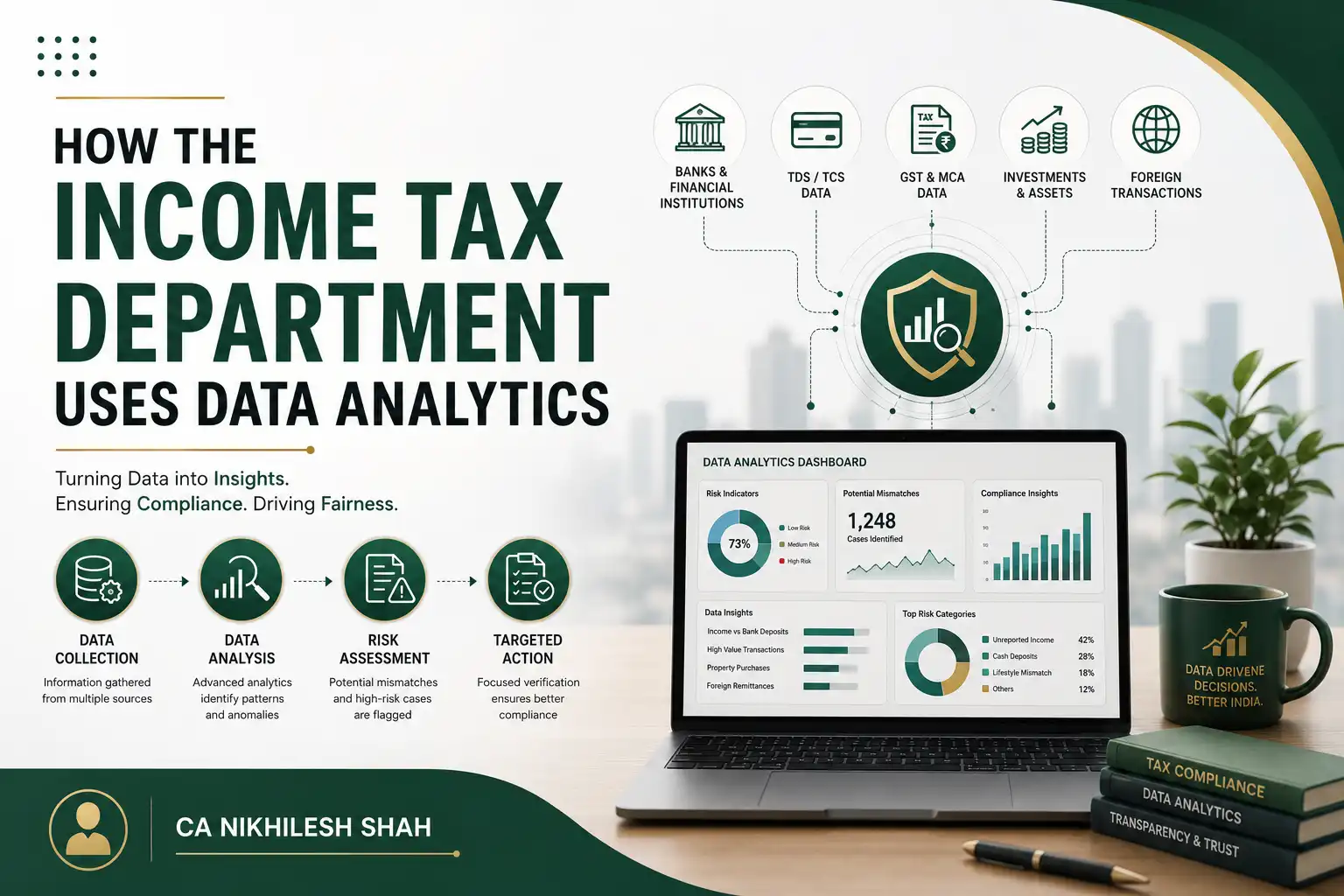
How the Income Tax Department Uses Data Analytics
Why Business Growth Requires Smart Tax Planning
A founder recently asked me during a business review meeting:
"Our company is growing rapidly. Sales have doubled, we've started working with larger clients, and transactions are happening across multiple platforms. We maintain proper books, but we're hearing that the Income Tax Department now uses artificial intelligence and data analytics. Should we be worried?"
My answer was simple:
Businesses that maintain transparent records and adopt proactive tax compliance have very little to fear.
The real concern is not that the Income Tax Department has become more technology-driven. The concern is that many businesses continue to follow outdated compliance practices while the tax administration has evolved significantly.
Today's tax environment is no longer dependent only on manual scrutiny or random assessments. The Income Tax Department increasingly relies on data analytics, artificial intelligence, machine learning, and information from multiple reporting systems to identify inconsistencies, unusual transaction patterns, and potential cases requiring verification.
For growing businesses, this means tax compliance has become a strategic business function rather than merely an annual filing obligation.
Businesses that integrate tax planning into their growth strategy are better positioned to attract investors, obtain financing, build credibility, and avoid unnecessary litigation.
The Business Challenge
Every growing business generates more financial data than ever before.
A startup may receive venture funding.
An agency may bill clients across different states.
A consultant may earn income from overseas assignments.
A manufacturer may claim input tax credits while expanding production.
A technology company may issue ESOPs and receive foreign investments.
Each transaction creates a digital footprint.
Many business owners still assume that if a return has been filed, their compliance responsibilities are complete.
In reality, filing a return is only one part of the compliance ecosystem.
Today, financial information flows to government systems through numerous channels, including:
- Banks and financial institutions
- TDS statements
- GST returns
- Securities transactions
- Property registrations
- Payment gateways
- Foreign remittance reporting
- Annual Information Statement (AIS)
- Statement of Financial Transactions (SFT)
- Registrar filings
- Employer reporting
- Mutual fund and brokerage reporting
Data from these sources is analysed together.
The objective is not simply to identify tax evasion but also to detect inconsistencies that may require clarification.
This makes accurate reporting and proper documentation more important than ever.
Understanding the Tax Landscape
One of the biggest changes in recent years has been the increasing use of technology in tax administration.
Rather than reviewing returns in isolation, tax authorities can compare information received from multiple independent sources.
For businesses, this means every significant transaction should be capable of being explained with appropriate records.
Matching Income Across Multiple Sources
Suppose a company reports turnover in its Income Tax Return that differs significantly from information available through TDS filings, GST returns, or financial reporting.
Such mismatches may attract further verification.
Many discrepancies arise from genuine accounting differences, timing issues, or reporting errors rather than intentional non-compliance.
However, without proper reconciliation, businesses may still receive notices seeking explanations.
Monitoring High-Value Transactions
Large financial transactions are reported under various statutory reporting requirements.
Examples include:
- Property purchases
- Significant cash deposits
- High-value investments
- Foreign remittances
- Securities transactions
- Certain banking activities
Businesses should ensure that these transactions align with their books of account and tax disclosures.
Artificial Intelligence and Risk Profiling
Modern tax administration increasingly uses risk-based assessment systems.
Rather than scrutinising every taxpayer equally, analytical models identify returns that display unusual trends, inconsistencies, or reporting anomalies.
Factors may include:
- Sudden changes in turnover
- Large expense claims
- Significant refund claims
- Unusual capital gains reporting
- Mismatches between reported income and financial transactions
- Inconsistent compliance history
Being selected for verification does not necessarily imply wrongdoing.
It simply means additional clarification may be required.
Importance of Accurate Documentation
Data analytics identifies potential issues.
Documentation resolves them.
Every financial position taken in a tax return should be supported through:
- Invoices
- Contracts
- Bank statements
- Purchase records
- Expense bills
- Board resolutions where applicable
- Loan agreements
- Investment records
- GST reconciliations
- Accounting records
Good documentation remains the strongest defence during any tax inquiry.
Practical Business Examples
Startup Receiving Investment
A technology startup raises funding from angel investors.
The investment is properly documented through shareholder agreements, board approvals, valuation reports, and regulatory filings.
When financial information is reviewed across different reporting systems, the business can easily explain every transaction because documentation is complete.
Digital Marketing Agency
A digital agency receives payments from domestic and international clients through multiple payment platforms.
Monthly reconciliation between invoices, bank receipts, GST records, and accounting software helps ensure consistent reporting.
This reduces the likelihood of discrepancies appearing in tax analytics.
Manufacturing Company
A manufacturer claims substantial depreciation after purchasing new machinery.
Since invoices, payment proofs, installation records, and accounting entries are properly maintained, the claim is fully supported if verification is required.
Independent Consultant
A consultant receives professional fees from several companies.
TDS deducted by clients is reconciled with Form 26AS before filing the Income Tax Return.
Any mismatch is identified and corrected before submission.
This proactive approach prevents unnecessary refund delays or tax demands.
Growing E-commerce Business
An online retailer sells products through multiple marketplaces while also operating its own website.
Sales data from e-commerce platforms, payment gateways, GST returns, inventory systems, and accounting software are reconciled every month.
As the business expands, maintaining consistency across these systems significantly reduces compliance risk.
Hidden Compliance Risks
The businesses that receive notices are not always those intentionally avoiding taxes.
Many notices arise because of avoidable mistakes.
Inconsistent Reporting
Differences between GST returns, Income Tax Returns, TDS statements, and financial statements are among the most common triggers for scrutiny.
Weak Documentation
Business expenses without invoices or supporting evidence become difficult to justify during assessments.
Ignoring AIS and Form 26AS
Many taxpayers file returns without reviewing information already available to the Income Tax Department.
Reconciling these records before filing helps identify missing income or incorrect TDS credits.
Delayed Accounting
Businesses that postpone bookkeeping until year-end often discover errors too late.
Monthly accounting reviews significantly improve reporting accuracy.
Personal and Business Transactions
Using business accounts for personal expenses - or vice versa - creates accounting complications and increases the risk of inconsistencies.
Large Transactions Without Planning
Major acquisitions, restructuring, investments, or asset transfers should be reviewed from both commercial and tax perspectives before execution.
Strategic Tax Planning Opportunities
Instead of viewing data analytics as a threat, businesses should use it as a reason to strengthen governance.
As a Chartered Accountant, I encourage clients to adopt the following practices:
Build real-time accounting systems.
Accurate monthly bookkeeping reduces year-end corrections and supports better decision-making.
Reconcile financial records regularly.
Match books with GST returns, TDS statements, AIS, Form 26AS, and bank records periodically - not just before filing returns.
Strengthen documentation.
Every major business transaction should have commercial justification supported by proper agreements and approvals.
Review tax positions before executing transactions.
Whether purchasing assets, raising investment, issuing ESOPs, restructuring operations, or expanding internationally, evaluate the tax implications in advance.
Use technology effectively.
Accounting software, automated reconciliations, document management systems, and compliance calendars improve both efficiency and accuracy.
Conduct periodic tax health checks.
Annual compliance reviews often identify issues before they develop into tax disputes.
Businesses that invest in preventive compliance usually spend less time responding to notices and more time focusing on growth.
Business Action Checklist
Before the next compliance cycle, every business should complete the following:
✔ Reconcile Income Tax Return, GST returns, and financial statements.
✔ Review AIS and Form 26AS.
✔ Match TDS credits with accounting records.
✔ Maintain complete invoices and supporting documentation.
✔ Keep contracts and agreements organised.
✔ Separate personal and business transactions.
✔ Review large financial transactions before execution.
✔ Conduct monthly bookkeeping and reconciliations.
✔ Preserve digital records securely.
✔ Schedule an annual tax compliance review with a Chartered Accountant.
✔ Train finance teams on documentation and reporting standards.
Conclusion
The Income Tax Department's increasing use of data analytics represents a significant shift in tax administration. Rather than relying primarily on manual scrutiny, tax authorities now analyse information from multiple reporting systems to identify inconsistencies and assess compliance risks more efficiently.
For businesses, this change should not be viewed as a challenge but as an opportunity to strengthen governance, improve financial reporting, and build long-term credibility.
Sustainable business growth depends not only on increasing revenue but also on maintaining transparent records, implementing strong internal controls, and making informed tax decisions throughout the year.
The most resilient businesses are those that treat tax compliance as part of their overall business strategy rather than a year-end obligation.
With robust documentation, timely reconciliations, proactive tax planning, and regular professional guidance, businesses can confidently navigate an increasingly data-driven tax environment while focusing on expansion, profitability, and long-term success.