

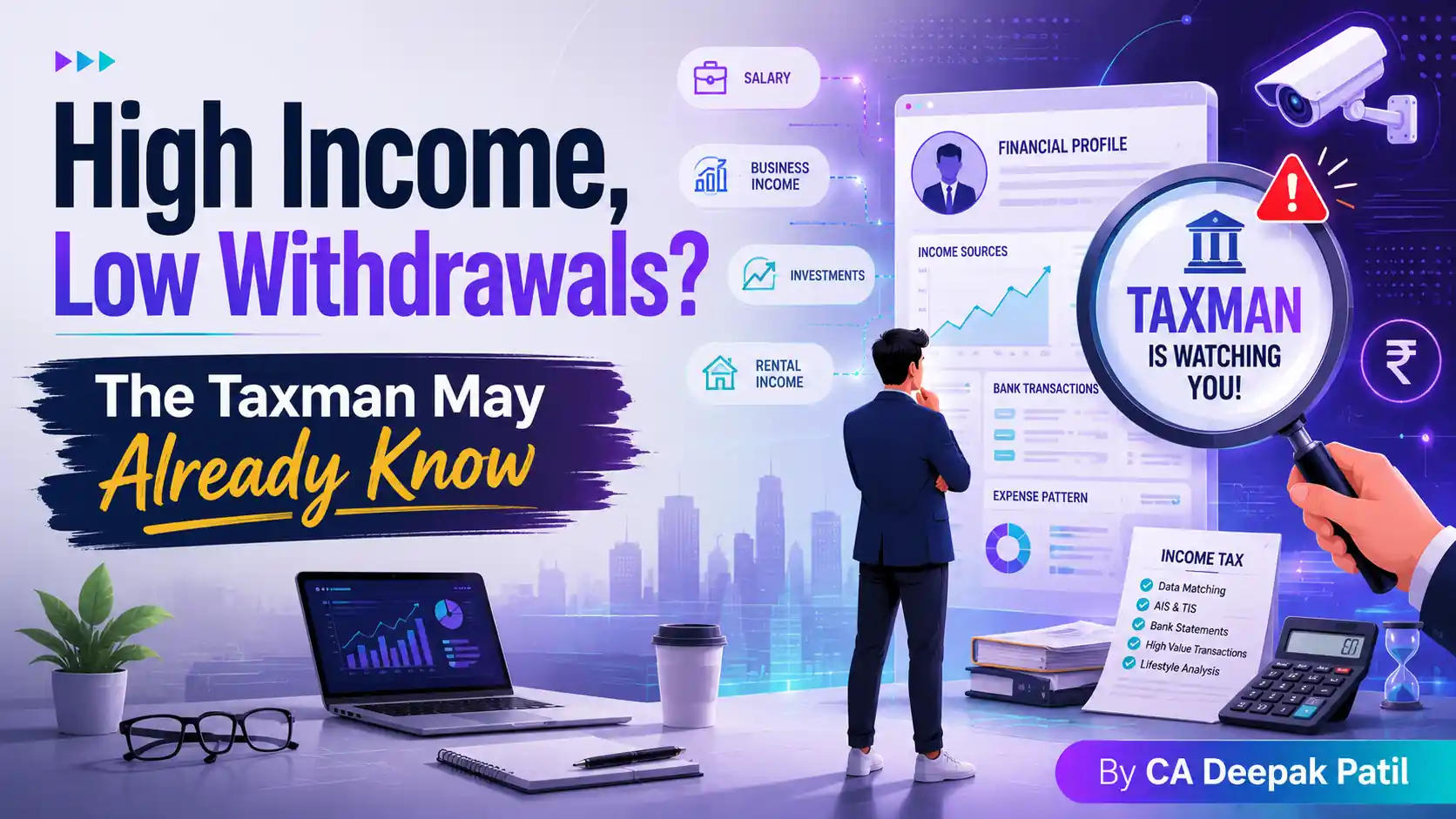
High Income, Low Withdrawals: The Invisible Trail the Taxman is Following
Imagine a bank account belonging to a high-earning corporate executive or a thriving business owner. Every month, massive white-collar salary credits or business invoices land safely in the account. The income tax returns are filed diligently, taxes are paid on time, and on paper, everything looks pristine.
But if you look closer at the debit side, a strange anomaly emerges.
Month after month, there are almost zero cash withdrawals. No major credit card payments. No lifestyle expenses reflecting in the bank statement. Just an accumulation of wealth or direct routing into investments.
To the untrained eye, this looks like the bank account of an extreme minimalist or a hyper-frugal saver. But to a senior tax investigator, this raises an immediate, glaring question: How is this person buying groceries, paying their domestic staff, filling up their luxury car, or funding their daily life?
Welcome to the modern era of tax enforcement, where what you don’t spend can tell a more compelling story than what you do.
The Geometry of Disconnect: When Income and Consumption Don't Match
For decades, traditional tax evasion tracking focused heavily on finding hidden income. Investigators looked for unrecorded cash receipts or undisclosed properties. However, advanced data analytics have flipped the script. Today, investigators track the consumption footprint to verify the legitimacy of the income disclosure.
When someone earns Rs. 50 Lakhs a year but their bank statement shows annual living expenses of just Rs. 50,000, a fundamental economic mismatch occurs. Human beings require basic sustenance, and high-income individuals typically maintain a certain standard of living. If your bank account doesn't reflect that lifestyle, tax algorithms flag a simple deduction: The lifestyle is being funded through unaccounted parallel cash channels.
This mismatch is where the "High Income, Low Withdrawal" trap triggers. The system starts checking if the taxpayer is absorbing cash business receipts directly into daily expenses without routing them through the banking system, or worse, reintroducing unaccounted cash into the economy through complex loops.
The Digital Panopticon: What Financial Data Authorities Can See
Gone are the days when tax officers had to manually rummage through physical ledgers. Today, the tax department operates an AI-driven data intelligence network. Your financial life is automatically mapped through an interconnected web of reporting.
1. The Annual Information Statement (AIS) and SFT
The Statement of Financial Transactions (SFT) forces banks, mutual funds, registries, and credit card companies to report high-value transactions automatically. This feeds directly into your AIS. If you buy shares, invest in a fixed deposit, or purchase property, the taxman knows about it before you even download your bank statement.
2. Digital Trails vs. Physical Reality
Every time you use your Permanent Account Number (PAN) or Aadhaar, a digital node is created. The tax department’s algorithms match these nodes against your reported income. If a taxpayer claims they have no money left for withdrawals because they save everything, the system instantly cross-references their investment portfolio. If the investments don't account for the remainder of the high income, the algorithm flags an anomaly.
Red Flags: Triggers That Spark Scrutiny
Taxpayers often trigger inquiries completely by accident, unaware of how their financial behavior appears on an investigator's screen. Here are the most common red flags:
- The Zero-Debit Phenomenon: Running a high-income primary account with zero utility payments, grocery bills, or fuel expenses over a prolonged period.
- The Credit Card Disconnect: Paying credit card bills using cash or routing the payments through a third-party account or a minor family member's account.
- Sudden High-Value Investments: Making large investments in real estate, mutual funds, or insurance policies while showing low capital withdrawals from your primary business or profession.
- The Extended Family Route: Transferring small, frequent sums to non-working family members (parents, homemaker spouses) who then withdraw massive amounts of cash, effectively masking the primary earner's consumption.
Real-Life Investigation Insights
Case 1: The Frugal Physician
A highly successful consultant surgeon reported an annual income of Rs. 80 Lakhs. He paid his taxes accurately. However, an analysis of his bank accounts revealed that his total annual cash and digital withdrawals amounted to less than Rs. 40,000. He had no credit cards in his name.
The investigative team didn't look at his bank; they looked at his ecosystem. A survey revealed he lived in a premium gated community, drove an imported SUV, and his children attended an expensive international school.
The school fees and community maintenance were being paid in cash, funded by under-the-table consultation fees collected from patients at his private clinic—cash that never entered his official bank account. The low withdrawal pattern was the thread that unraveled the entire parallel practice.
Case 2: The Silent Partner
A partner in a manufacturing firm showed high capital accumulation in the firm but zero personal drawings for two consecutive financial years. When questioned by the system, the partner claimed they were living off past savings.
A deep dive into the AIS of his immediate family members revealed that his dependent spouse had suddenly started purchasing high-value digital gold and clearing massive lifestyle expenses. The cash generated by the business was being routed through family channels to keep the partner's personal account looking clean and inactive.
Staying Compliant: How to Align Your Financial Story
As a Chartered Accountant, my advice to high earners is simple: Your financial statements must tell a logical, human story.
To ensure your accounts don't invite unwanted scrutiny, practice these compliance habits:
- Consolidate Your Consumption: Ensure that your regular lifestyle expenses—rent, insurance premiums, school fees, utilities, and fuel—are cleanly routed through your primary, declared bank accounts.
- Document Gift and Loan Transactions: If you are genuinely surviving on a family loan, an inheritance, or past accumulated savings, maintain clear, stamped legal documentation and ensure these are reflected in your tax disclosures.
- Audit Your Own AIS Regularly: Log into your income tax portal quarterly. Review your AIS and Taxpayer Information Summary (TIS) to ensure no misreported high-value transactions are creating false red flags.
- Account for Small Business Cash Legally: If your business legitimately handles cash transactions, ensure they are fully recorded in the books of accounts and that personal cash usage is properly accounted for as personal drawings.
Key Takeaways
- Compliance goes beyond income disclosure: Tax authorities track both what you earn and how you sustain your lifestyle.
- Anomalies invite algorithms: Unusually low bank withdrawals alongside high incomes trigger automated risk-differentiation systems.
- Data integration is absolute: The AIS and SFT bridge the gap between banks, registries, lifestyle spends, and your tax returns.
- Transparency is your best defence: A clean, traceable digital trail of everyday expenses prevents complex tax investigations.
Frequently Asked Questions
Q: Is it illegal to save most of my income and live a frugal lifestyle?
A: Absolutely not. Frugality is perfectly legal. However, if your lifestyle expenses are near zero on paper, you must be able to demonstrate exactly how your basic living needs are met if an inquiry arises.
Q: How does the Income Tax Department know if I spend cash?
A: They don't track the cash in your wallet directly, but they track the assets you buy with it. When cash turns into real estate, luxury goods, foreign travel, or high-value deposits, those systems report the transaction via your PAN, exposing the source.
Q: Can I avoid scrutiny by using my credit cards instead of withdrawing cash?
A: Credit card spend is fully tracked. Credit card payments exceeding Rs. 1 Lakh in cash or Rs. 10 Lakhs via banking channels annually are automatically reported to the tax department through SFT.