Whether you are a landlord earning rental income, a startup renting your first office, or an SME leasing a commercial space - understanding GST on rent is no longer optional. It is a compliance requirement that directly affects your tax liability and cash flow.
GST on rental income continues to be one of the most misunderstood areas in indirect taxation. Business owners assume it does not apply to them. Landlords believe rental income is outside GST. And compliance officers get confused when residential properties are rented to companies.
The rules are not complicated once you understand the logic. This guide breaks down everything you need to know - in plain language, with practical examples - so you can stay compliant and avoid costly errors.
Section 1: Is Renting Property Taxable Under GST?
Yes - in most cases. Under GST law, renting or leasing of immovable property is classified as a supply of service. This means it falls within the GST framework just like any other service.
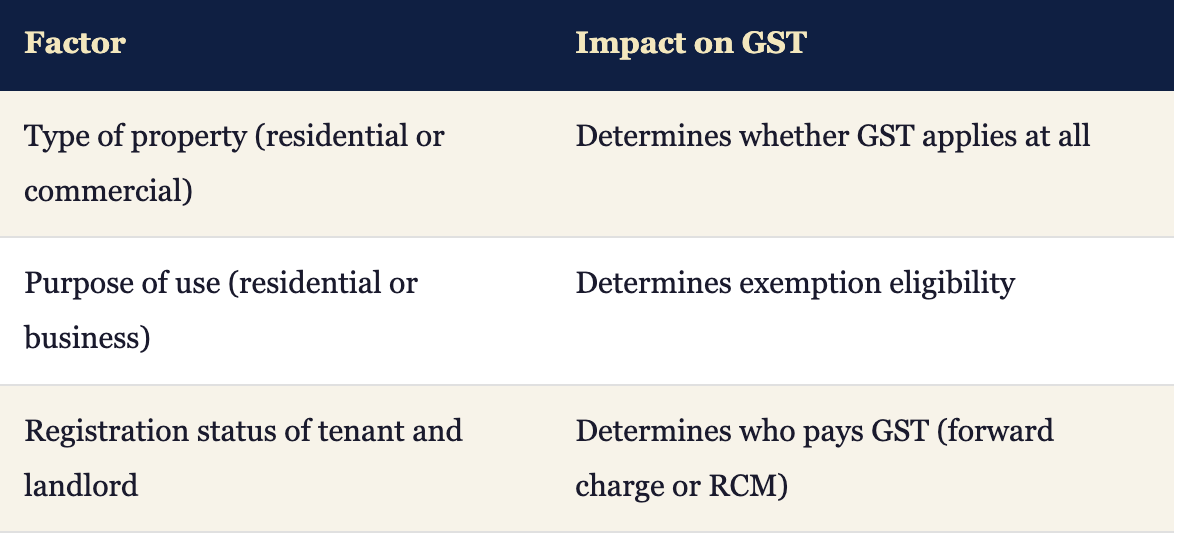
However, the tax treatment depends on two key factors:
Section 2: GST on Residential Property Rent
When Residential Property is Rented for Residential Use
If a residential property - a flat, house, or apartment - is rented out for residential living, GST is fully exempt. This exemption applies regardless of who the landlord is or how much rent is being charged.
A family renting a 2BHK flat for ₹30,000 per month pays no GST. Simple.
When Residential Property is Rented to a Business or GST-Registered Person
This is where things get important. If a GST-registered person or business rents a residential property - even for using it as staff accommodation or a guest house - GST at 18% applies under the Reverse Charge Mechanism (RCM).
The key word here is "GST-registered tenant." If the tenant is registered under GST, the exemption no longer applies regardless of actual use.
Section 3: GST on Commercial Property Rent
Renting of commercial property - offices, shops, warehouses, showrooms, factories - is taxable under GST at 18%. This applies whether the landlord is registered or not.
Section 4: Understanding Reverse Charge Mechanism (RCM) on Rent
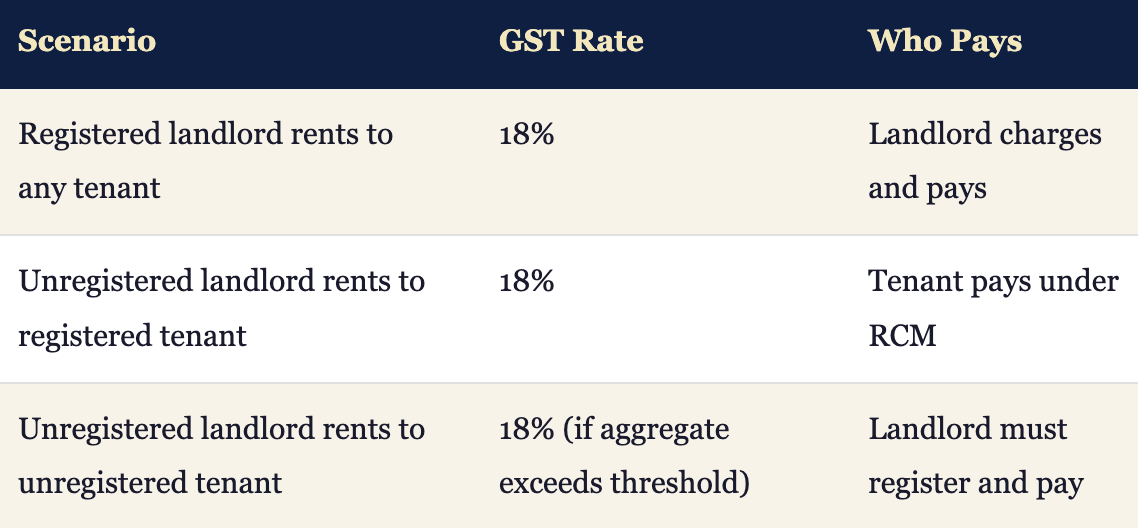
Under RCM, the recipient of the service (tenant) pays GST directly to the government - not to the landlord. The landlord does not charge GST on the invoice in such cases.
RCM on rent applies in two main situations:
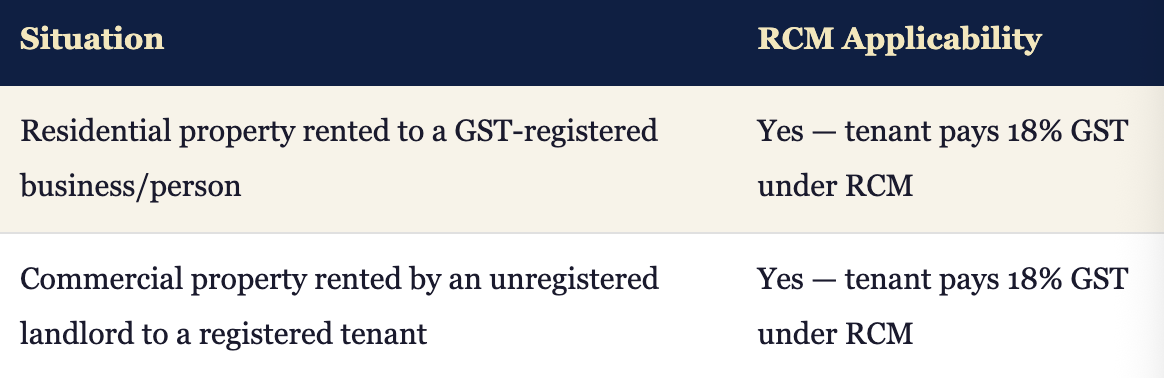
Under RCM, the tenant must self-invoice, deposit GST, and file returns accordingly. The landlord does not need to register solely because of RCM liability on their tenant.
Section 5: Input Tax Credit (ITC) on Rent
ITC allows businesses to offset the GST paid on rent against their output GST liability - effectively reducing their tax cost.
When Can ITC Be Claimed?
A business can claim ITC on rent paid if the rented property is used for business purposes and all of the following conditions are met:
The tenant is registered under GST. GST has actually been paid (either to the landlord or under RCM). The premises are used for taxable supplies and not personal or exempt use. A valid tax invoice or self-invoice (in RCM cases) exists.
Restrictions on ITC
ITC cannot be claimed on rent paid for residential accommodation provided to employees - even if GST was paid under RCM. This is an explicit restriction under GST law.
Section 6: GST Registration Requirement for Landlords
A landlord providing rental services must register under GST if their aggregate annual turnover from all taxable supplies exceeds ₹20 lakhs (₹10 lakhs for certain special category states).
Rental income from exempt supplies (like residential property rented for residential use) does not count toward this threshold.
So a landlord earning only ₹15 lakhs/year from residential rentals for residential use does not need GST registration. But a landlord earning ₹12 lakhs from a shop and ₹10 lakhs from a godown - totaling ₹22 lakhs in taxable supplies - must register.
Section 7: Common Mistakes Property Owners Make
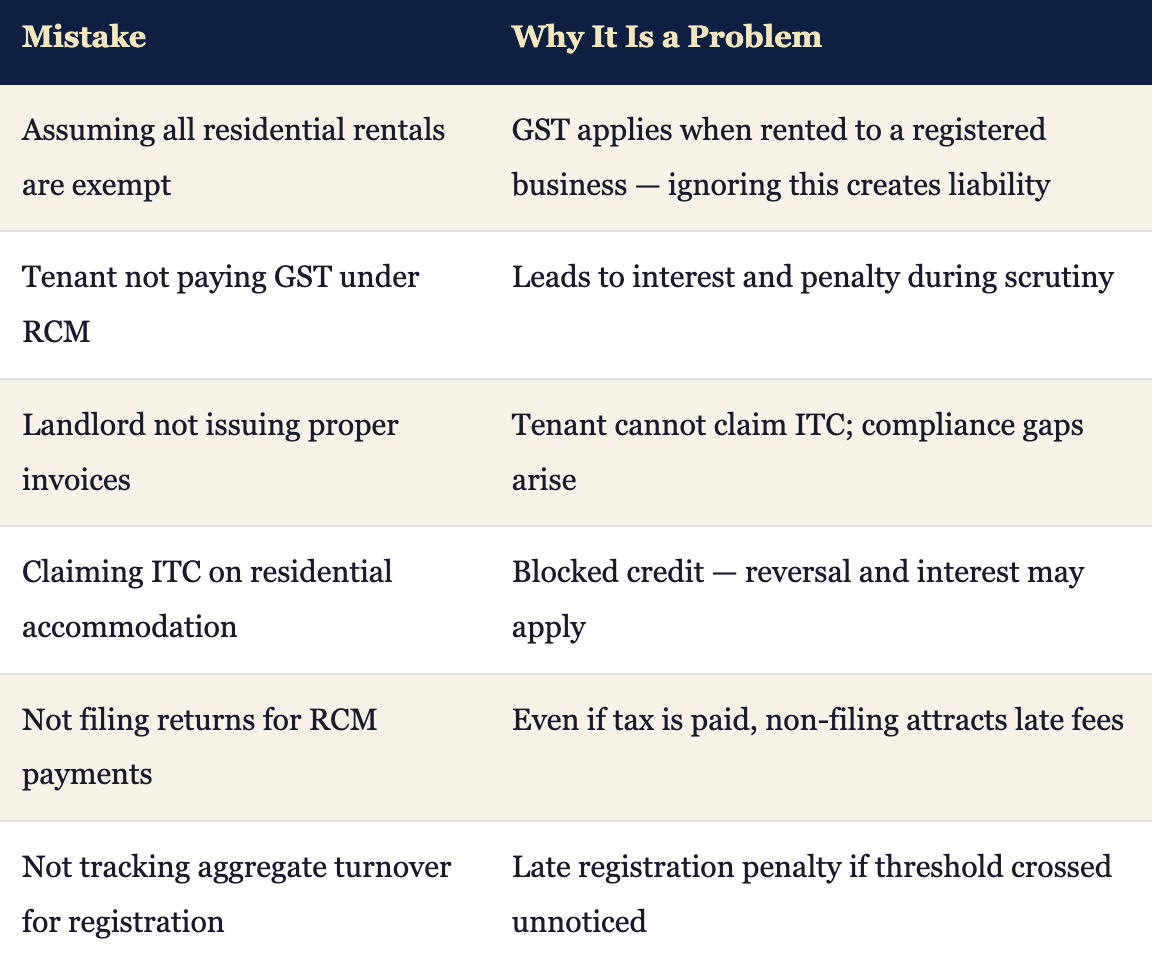
These are the errors we see most often during GST audits and assessments: