

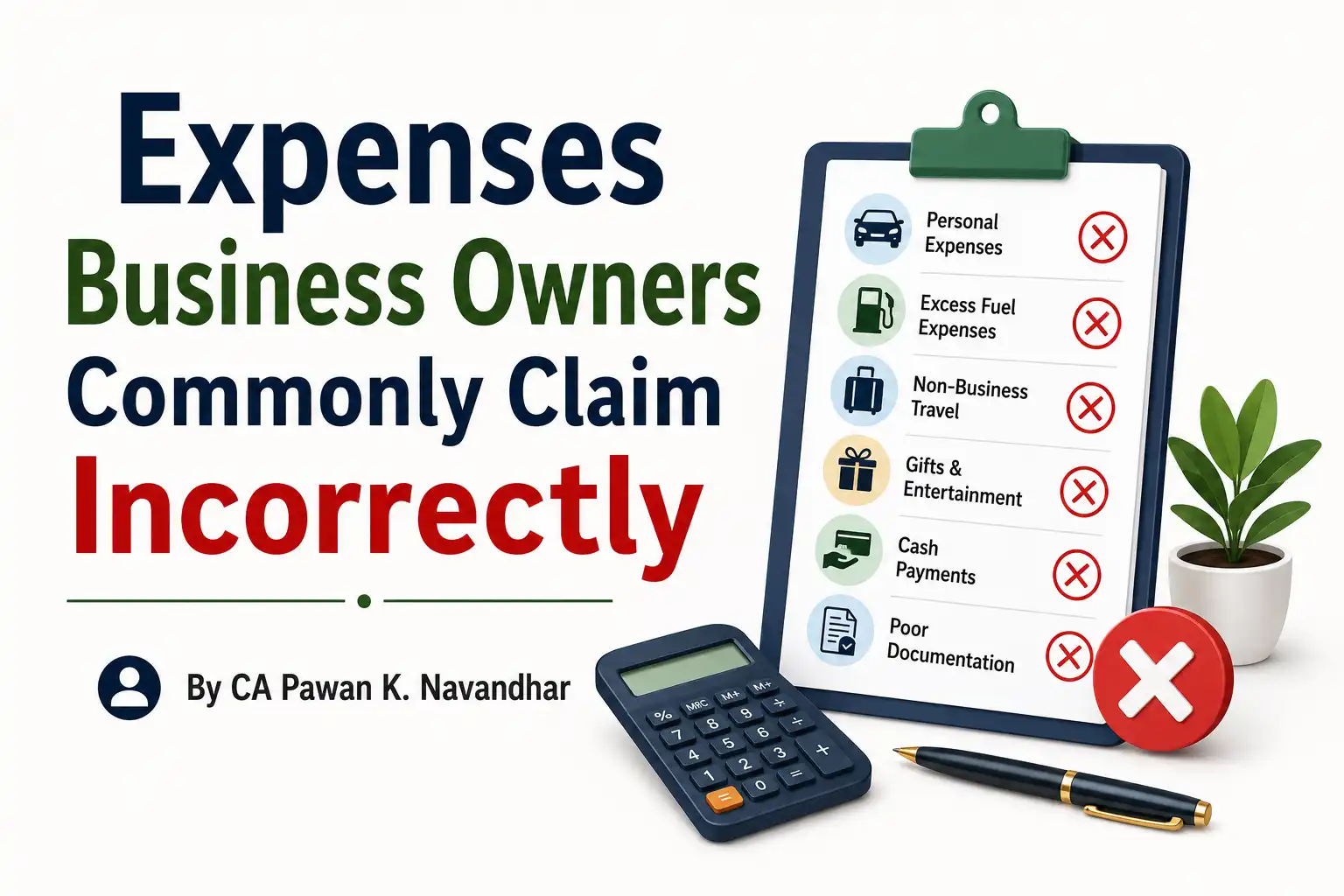
Expenses Business Owners Commonly Claim Incorrectly
Why This Matters
For most business owners, claiming legitimate business expenses is a normal part of managing tax liability. After all, the Income Tax Act allows businesses to deduct expenses incurred wholly and exclusively for business purposes.
The problem begins when business owners assume that every outgoing payment automatically qualifies as a deductible expense.
In practice, many tax disputes arise not because income was hidden but because expenses were claimed incorrectly, inadequately documented, or mixed with personal expenditure.
As tax authorities increasingly rely on data analytics, financial reporting, and scrutiny of books of accounts, incorrectly claimed expenses can lead to disallowances, additional tax demands, interest, and prolonged assessments.
The objective should not be to maximize expense claims at any cost. It should be to ensure that every deduction claimed can be justified, documented, and defended if questioned.
The Core Issue
Most business owners are not intentionally claiming incorrect expenses.
The issue usually arises because business and personal finances often overlap.
A business owner may use the same vehicle for business and personal travel. A mobile phone may serve both family and business purposes. A foreign trip may combine client meetings with a family vacation.
The challenge is determining which portion genuinely relates to business activity.
The Income Tax Act generally permits deductions for expenses incurred wholly and exclusively for business purposes. When personal benefit becomes involved, the tax position becomes more complicated.
This is why certain categories of expenses repeatedly attract scrutiny during assessments and audits.
Understanding the Tax Position
The starting principle is straightforward:
For an expense to be deductible, it should generally be incurred for the purpose of carrying on the business or profession.
However, tax authorities may question deductions where:
- Personal expenses are claimed as business expenses.
- Supporting documentation is inadequate.
- The expenditure appears excessive.
- The business purpose cannot be established.
- Statutory conditions have not been satisfied.
The issue is often less about the nature of the expense and more about the ability to demonstrate its connection to business operations.
Proper records frequently determine whether an expense survives scrutiny.
Real-World Business Scenarios
1. Vehicle Expenses
Vehicle-related expenses are among the most commonly disputed deductions.
A business owner uses a car for client meetings, vendor visits, and business travel. The same vehicle is also used for personal errands and family trips.
Claiming 100% of fuel, maintenance, insurance, and running costs without maintaining usage records may create difficulties during assessment.
The key question is whether the business portion can be reasonably supported.
2. Mobile Phone and Internet Expenses
Entrepreneurs, consultants, and startup founders often use the same phone and internet connection for both personal and professional activities.
While business usage may qualify for deduction, claiming the entire expense without considering personal use can become problematic.
3. Travel and Accommodation Costs
Business travel is generally deductible when undertaken for commercial purposes.
However, complications arise when:
- Family members accompany the business owner.
- Leisure activities are combined with business travel.
- Documentation is incomplete.
Without a clear business purpose and supporting records, tax authorities may challenge the deduction.
4. Meals and Entertainment
Client meetings frequently involve restaurant bills, hospitality expenses, and networking activities.
While genuine business-related expenses may be supportable, excessive personal dining presented as business expenditure often attracts scrutiny.
5. Home Office Expenses
Remote work has increased the use of home offices.
Business owners sometimes claim substantial household expenses without maintaining a reasonable basis for allocation between personal and business use.
6. Gifts and Promotional Expenses
Businesses often provide gifts to clients, vendors, and channel partners.
Problems arise when:
- Recipients cannot be identified.
- Business purpose is unclear.
- Supporting records are unavailable.
7. Family Member Payments
Payments to spouses, children, parents, or other relatives can be legitimate business expenses when actual services are provided.
However, tax authorities may examine whether compensation is commercially reasonable and supported by evidence.
Risks You Shouldn't Ignore
Expense Disallowances
The most immediate consequence of an incorrect claim is disallowance of the expense, resulting in higher taxable income.
Additional Tax and Interest
Disallowed expenses often increase tax liability and may also result in interest obligations.
Increased Scrutiny
Questionable deductions frequently encourage deeper examination of books and financial records.
Weak Documentation
Even legitimate expenses can become problematic when invoices, agreements, payment records, or supporting evidence are unavailable.
Personal and Business Mixing
One of the most common compliance weaknesses among small businesses is the failure to separate personal and business expenditure.
Practical Recommendations
Business owners should focus less on maximizing deductions and more on strengthening documentation.
A good expense claim should answer three questions:
- Was the expense actually incurred?
- Was it incurred for business purposes?
- Can it be supported with evidence?
Practical steps include:
- Maintaining separate business bank accounts.
- Using dedicated business credit cards where possible.
- Preserving invoices and receipts.
- Documenting business travel purposes.
- Creating clear reimbursement policies.
- Reviewing expense classifications periodically.
Businesses that maintain disciplined recordkeeping generally face fewer problems during assessments.
The strongest tax position is not necessarily the most aggressive one - it is the most defensible one.
Action Checklist
Before claiming a business expense, ask:
✓ Is the expense genuinely business-related?
✓ Do I have supporting invoices or receipts?
✓ Was payment made through traceable channels?
✓ Is there any personal element involved?
✓ Can I explain the business purpose clearly?
✓ Have I maintained supporting records?
✓ Would the claim withstand an assessment review?
✓ Have I separated personal and business spending?
✓ Are related-party payments properly documented?
✓ Has the expense been recorded correctly in the books?
Conclusion
Incorrect expense claims are rarely the result of complex tax law. More often, they stem from weak documentation, poor recordkeeping, and the assumption that every payment connected to a business owner qualifies as a business deduction.
As compliance standards continue to evolve, tax authorities increasingly focus on substance rather than labels.
A vehicle expense remains a vehicle expense only if it serves a business purpose. A travel expense remains deductible only if the business objective can be demonstrated.
For business owners, the goal should not be to claim the maximum number of deductions. It should be to claim the right deductions with confidence.
Well-documented, commercially justifiable expenses are far more valuable than aggressive claims that create future tax disputes.