
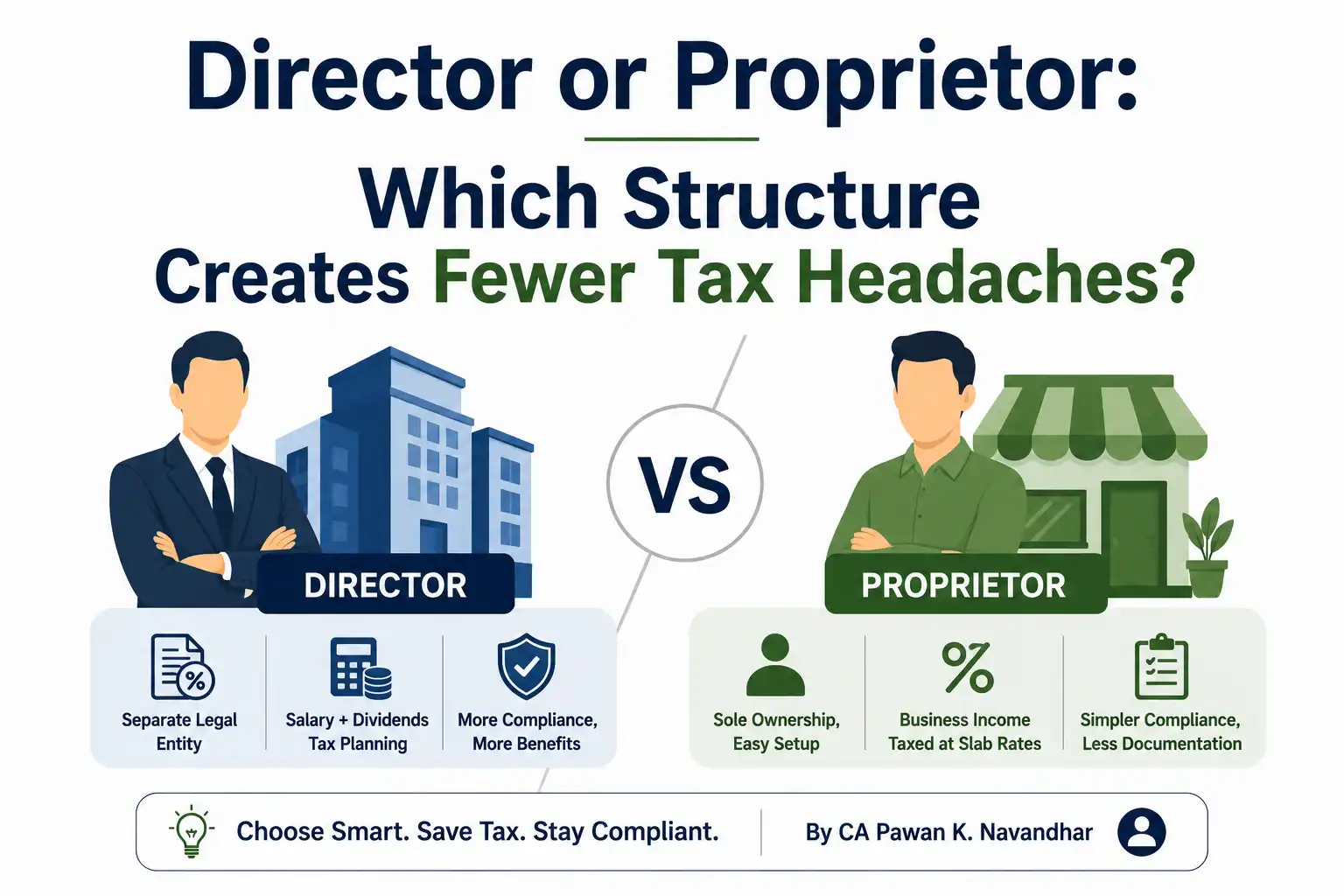
Director or Proprietor: Which Structure Creates Fewer Tax Headaches?
Why This Matters
Many businesses begin with a simple proprietorship because it is easy to start, inexpensive to operate, and requires minimal compliance. As the business grows, however, owners often begin considering a private limited company structure and become directors of their own company.
At this stage, the discussion is usually driven by tax-saving claims, social media advice, or suggestions from peers. Unfortunately, many entrepreneurs choose a structure without fully understanding its long-term tax and compliance implications.
The better question is not which structure looks more professional. The real question is which structure aligns with the business's size, growth plans, compliance capacity, and tax objectives.
Choosing the wrong structure may not create problems immediately, but it can increase compliance costs, administrative burdens, and tax complications over time.
The Core Issue
Business owners often assume that incorporating a company automatically reduces taxes.
Others believe that a proprietorship is always simpler and therefore better.
Neither assumption is universally correct.
A proprietorship and a private limited company operate under fundamentally different tax and legal frameworks.
In a proprietorship:
- The business and owner are legally the same.
- Business income is taxed in the proprietor's hands.
- Compliance requirements are comparatively lower.
- Decision-making is straightforward.
In a company:
- The company is a separate legal entity.
- Profits are taxed at the company level.
- Directors and shareholders have distinct roles.
- Compliance obligations increase significantly.
The objective should not be to find a universally superior structure but to understand which option creates fewer challenges for a particular business situation.
Understanding the Tax Position
Proprietorship Taxation
A proprietorship does not pay tax separately.
The business income becomes part of the proprietor's personal income and is taxed according to applicable income tax slab rates.
This arrangement works efficiently for many small and medium-sized businesses because profits can be withdrawn without additional taxation formalities.
However, as profits increase substantially, the tax burden may also increase depending on the applicable tax regime.
Company Taxation
A private limited company is taxed separately from its owners.
The company pays tax on its profits, while directors may receive remuneration and shareholders may receive dividends subject to applicable tax provisions.
While companies may benefit from certain tax rates and planning opportunities, they also face additional compliance obligations including:
- Corporate filings
- Board meetings
- Statutory records
- Annual ROC compliances
- Audit requirements where applicable
Therefore, tax savings alone should not determine the decision.
Limited Liability Considerations
Tax is only one aspect of the discussion.
Many businesses choose a company structure because it provides limited liability protection, which can become important when operations expand, employees are hired, or external investors become involved.
Real-World Business Scenarios
Scenario 1: The Freelance Consultant
A marketing consultant earns professional income of ₹15 lakh annually and operates independently without employees or investors.
In this case, a proprietorship may often be sufficient because compliance remains manageable and the business model is relatively simple.
Creating a company merely for perceived tax benefits may increase administrative obligations without delivering significant practical advantages.
Scenario 2: The Growing Startup
A technology startup expects external funding within the next two years.
Investors generally prefer structured corporate entities rather than proprietorships.
In such situations, incorporating a company may provide advantages that extend beyond taxation.
Scenario 3: The Family Business
A family-owned trading business has operated successfully for years as a proprietorship.
As turnover increases and expansion plans emerge, the owners begin evaluating whether a company structure would provide better governance and succession planning.
The decision should involve both tax and long-term business considerations.
Scenario 4: The Agency Owner
A digital marketing agency employs multiple team members and serves large corporate clients.
As operational risks increase, limited liability and organizational credibility may become important factors supporting a company structure.
Risks You Shouldn't Ignore
Choosing a Company Solely for Tax Reasons
Many business owners are attracted by claims that incorporation automatically reduces taxes.
In practice, compliance costs, professional fees, and administrative requirements must also be considered.
Ignoring Compliance Responsibilities
Running a company involves ongoing statutory obligations.
Failure to meet these requirements can result in penalties and regulatory complications.
Delaying Structural Changes
Some businesses continue operating as proprietorships long after their scale and risk profile suggest a different structure may be more appropriate.
Mixing Personal and Business Transactions
This issue affects both proprietorships and companies.
However, it often creates greater scrutiny when corporate governance standards are expected.
Poor Remuneration Planning
Business owners transitioning to a company structure frequently underestimate the importance of properly planning director remuneration, profit withdrawals, and dividend strategies.
Practical Recommendations
Before deciding between a proprietorship and a company, business owners should evaluate:
- Expected revenue growth
- Funding requirements
- Compliance capacity
- Operational risks
- Expansion plans
- Tax implications
- Ownership structure
- Long-term succession goals
For many early-stage businesses, simplicity can be valuable.
For growing businesses seeking investment, expansion, or stronger governance, a company structure may offer advantages despite additional compliance obligations.
The decision should be driven by business strategy rather than tax myths.
A structure that works today should also support where the business is likely to be three to five years from now.
Action Checklist
Before choosing or changing your business structure, ask:
✓ What are my expected profits over the next few years?
✓ Do I plan to raise external funding?
✓ Am I comfortable with additional compliance requirements?
✓ Does my business face significant legal or operational risks?
✓ Will I require multiple shareholders in the future?
✓ Have I compared the total compliance costs of both structures?
✓ How will profits be withdrawn from the business?
✓ Is limited liability important for my industry?
✓ Does the structure support long-term growth plans?
✓ Have I obtained professional advice before making the decision?
Conclusion
The debate between becoming a proprietor and operating through a company is often oversimplified as a tax-saving decision.
In reality, the choice affects taxation, compliance, governance, liability protection, fundraising opportunities, and long-term business growth.
For smaller businesses and independent professionals, a proprietorship may continue to be the most practical and efficient structure.
For businesses pursuing expansion, investment, scalability, or stronger governance, a company structure may provide meaningful advantages despite higher compliance obligations.
The best structure is rarely the one that promises the lowest tax bill today. It is the one that supports sustainable growth while keeping tax and compliance challenges manageable in the future.