

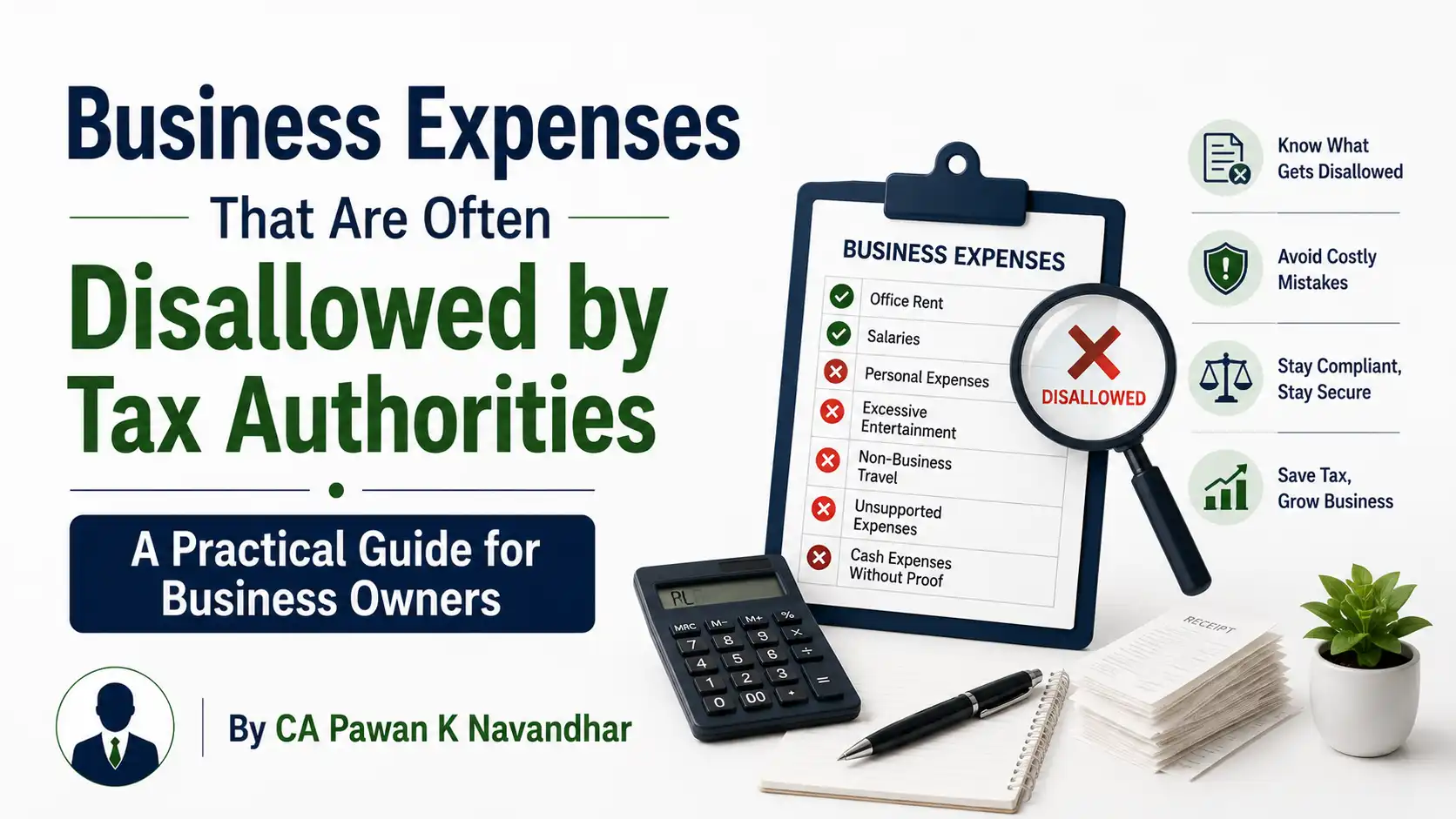
Business Expenses That Are Often Disallowed by Tax Authorities
Why This Issue Creates Compliance Risk
Every business aims to reduce its tax liability by claiming legitimate business expenses. Whether it is rent, salaries, travel costs, marketing expenses, or professional fees, allowable deductions help determine the actual taxable profit of the business.
However, one of the most common reasons businesses receive tax notices or face additions during assessments is the claim of expenses that cannot be adequately justified.
In many cases, business owners assume that every payment made through the business account automatically qualifies as a deductible expense. Unfortunately, tax authorities evaluate not only whether an expense was incurred, but also why it was incurred, whether it was genuinely for business purposes, and whether sufficient documentation exists to support the claim.
When expenses are disallowed, businesses may face:
- Increased taxable income.
- Additional tax liability.
- Interest and applicable penalties.
- Extended assessments and scrutiny.
- Greater compliance costs.
The objective should not be to maximize deductions at any cost.
Instead, businesses should focus on claiming expenses that are genuine, properly documented, and clearly connected to business operations.
Understanding the Tax Position
The Income Tax Act generally allows businesses to claim expenses that are incurred wholly and exclusively for the purpose of carrying on business or profession, subject to applicable conditions.
This means an expense should have a genuine business purpose.
Merely making a payment does not automatically make it deductible.
Tax authorities often examine:
- The commercial necessity of the expense.
- Supporting invoices.
- Payment records.
- Contracts or agreements.
- Whether the expense is personal or business-related.
- Whether statutory compliance requirements have been met.
If adequate evidence is unavailable or the expense appears excessive, personal, or unrelated to business activities, it may be disallowed during assessment.
Strong documentation often becomes just as important as the expense itself.
Common Business Situations
Many disallowances arise from everyday business decisions rather than intentional non-compliance.
Example 1: Personal Expenses Paid from Business Account
A business owner pays personal holiday expenses using the company's bank account and records them as business travel.
Although the payment appears in the books, it does not qualify as a genuine business expense.
Example 2: Cash Payments Without Supporting Documents
A contractor records substantial cash expenses but maintains no invoices or receipts.
Without supporting evidence, proving the business purpose of these payments becomes difficult.
Example 3: Excessive Family Remuneration
A business pays a high salary to a family member without clearly defining responsibilities or maintaining employment records.
The absence of commercial justification may result in questions regarding the deduction.
Example 4: Entertainment Expenses
A company incurs hospitality expenses but fails to maintain details regarding business meetings, attendees, or the commercial purpose.
Incomplete documentation weakens the claim.
Example 5: Vehicle Expenses
A proprietor uses one vehicle for both personal and business purposes but claims the entire running cost as a business expense without maintaining usage records.
This may invite scrutiny regarding the business portion of the expenditure.
Example 6: Consultancy Charges
A startup records consultancy expenses without written agreements, invoices, or evidence that services were actually provided.
Supporting documentation is essential to establish the legitimacy of the payment.
Mistakes Frequently Seen
Several recurring mistakes increase the likelihood of expense disallowances.
Mixing Personal and Business Expenditure
This is one of the most common compliance issues.
Personal expenses should never be presented as business deductions.
Maintaining Incomplete Documentation
Businesses often retain payment records but lose invoices, contracts, or work completion evidence.
Proper documentation supports the commercial purpose of every expense.
Claiming Every Expense Automatically
Not every payment qualifies as a deductible business expense.
Each expense should be evaluated based on its connection with business activities.
Ignoring Statutory Compliance
Certain deductions may depend upon satisfying specific legal requirements, including timely payments or applicable tax compliances.
Businesses should review these conditions carefully before claiming deductions.
Poor Bookkeeping
Incorrect accounting entries, duplicate expenses, or incomplete ledgers increase the chances of errors during assessment.
Reliable bookkeeping remains the foundation of tax compliance.
Delaying Record Collection
Waiting until assessment begins to organise invoices and supporting documents often creates avoidable complications.
Documentation should be maintained throughout the financial year.
Potential Consequences
Disallowed expenses affect far more than the current year's tax liability.
Higher Taxable Income
When an expense is disallowed, taxable profits increase accordingly.
This results in additional tax payable.
Interest and Applicable Penalties
Where required under the applicable provisions, businesses may also become liable for interest or penalties arising from incorrect claims.
Preventive compliance is generally more cost-effective than corrective action.
Assessment Proceedings
Unsupported expense claims frequently lead to requests for additional documentation and explanations.
Management time that could have been spent on business growth is diverted towards compliance.
Cash Flow Impact
Unexpected tax demands affect working capital and business liquidity, particularly for SMEs and startups.
Good documentation helps reduce such surprises.
Reduced Business Credibility
Consistently weak accounting practices may create concerns among lenders, investors, and other stakeholders reviewing the financial statements.
Disciplined financial reporting strengthens long-term business confidence.
Compliance Best Practices
Businesses can significantly reduce disallowance risks through disciplined financial management.
Separate Business and Personal Finances
Maintain separate bank accounts and accounting records.
This reduces confusion and improves transparency.
Preserve Complete Documentation
Maintain:
- Tax invoices.
- Bills.
- Contracts.
- Purchase orders.
- Payment proofs.
- Delivery records.
- Work completion reports where applicable.
Comprehensive documentation strengthens every deduction claimed.
Review Expenses Periodically
Instead of reviewing expenses only at year-end, conduct periodic internal reviews throughout the financial year.
Early identification of issues allows timely corrections.
Maintain Commercial Justification
Every significant expense should have a clear business purpose.
Businesses should be prepared to explain why the expenditure was necessary.
Follow Proper Approval Processes
Internal approvals for high-value expenses improve governance and create stronger audit trails.
This is particularly useful for growing businesses.
Obtain Professional Review
Before finalising financial statements and filing the Income Tax Return, review significant expenses with a Chartered Accountant.
Professional review often identifies weak documentation or compliance gaps before they become assessment issues.
Practical Checklist
Before claiming any business expense, consider the following checklist:
✔ Is the expense genuinely connected to business operations?
✔ Is a valid invoice available?
✔ Has payment been properly recorded?
✔ Are contracts or supporting agreements maintained?
✔ Can the commercial purpose be explained?
✔ Have personal expenses been excluded?
✔ Have statutory compliance requirements been satisfied?
✔ Are accounting records accurate and complete?
✔ Have significant expenses been reviewed before filing the tax return?
Strong documentation today can prevent difficult explanations tomorrow.
Conclusion
Business expenses play an important role in determining taxable profits, but claiming deductions requires more than recording payments in the books of account.
Tax authorities increasingly focus on commercial substance, supporting documentation, and compliance with applicable tax provisions.
Businesses that maintain disciplined accounting practices, preserve complete records, and review expenses periodically are far better positioned to withstand scrutiny during assessments.
Rather than attempting to maximize deductions aggressively, entrepreneurs, professionals, startups, and SMEs should focus on claiming expenses that are genuine, necessary, and fully supported.
A preventive compliance approach not only reduces the likelihood of disallowances but also improves financial transparency, strengthens business governance, and supports sustainable long-term growth.