

Filing your Income Tax Return (ITR) has become much more data-driven than it was a few years ago. Today, the Income Tax Department already has access to information about your salary, bank interest, investments, property transactions, stock market activity, foreign remittances, and several other financial transactions. This information is collected from banks, employers, financial institutions, registrars, mutual funds, and other reporting entities.
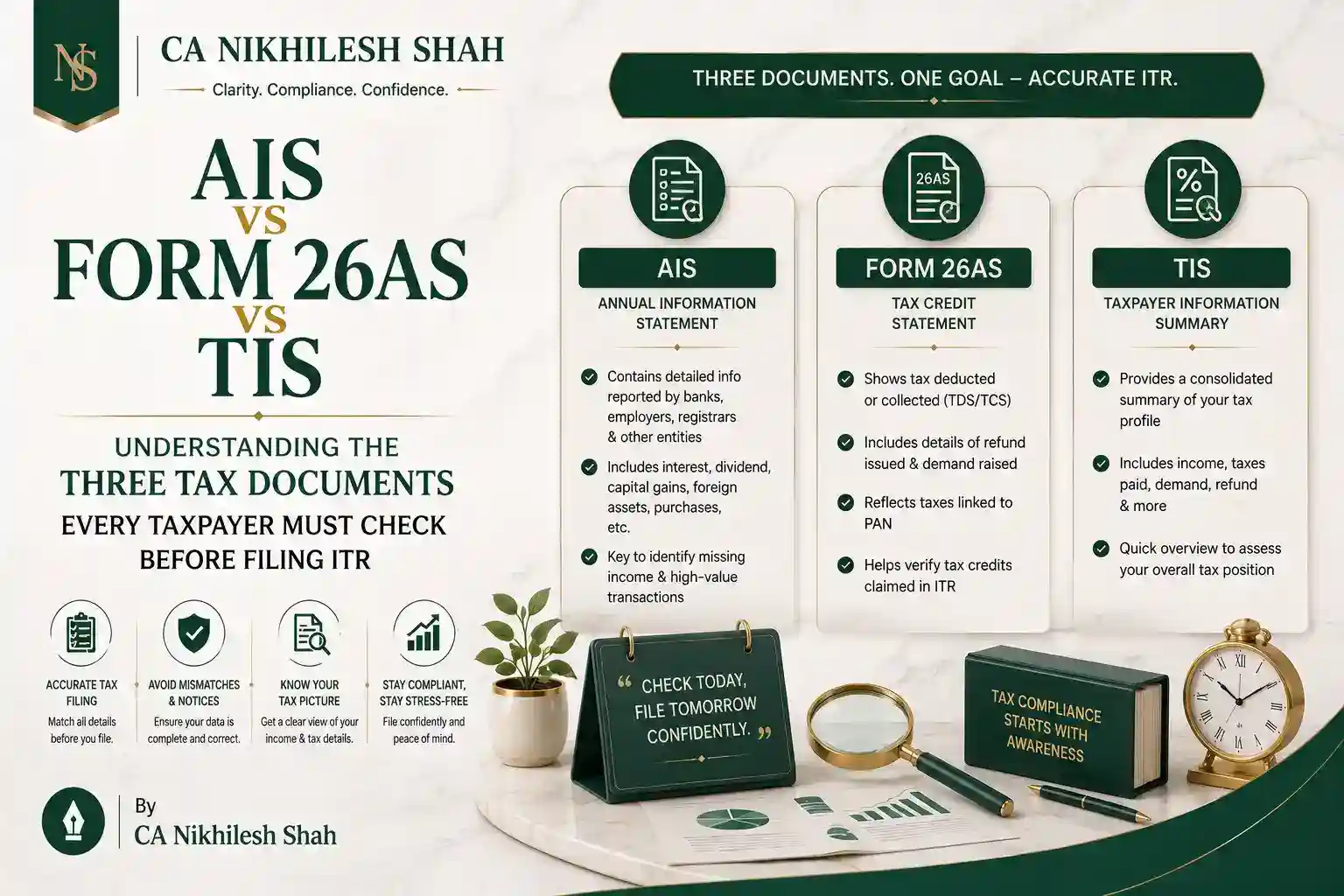
To help taxpayers verify this information before filing their returns, the Income Tax Department provides three important documents - Annual Information Statement (AIS), Form 26AS, and Taxpayer Information Summary (TIS).
Many taxpayers assume these documents are identical, but each serves a different purpose. Understanding the differences can help you file an accurate return, avoid notices, and reduce the chances of scrutiny.
What is Form 26AS?
Form 26AS is a consolidated tax statement that primarily reflects taxes deducted or collected against your Permanent Account Number (PAN).
It generally contains information such as:
- Tax Deducted at Source (TDS)
- Tax Collected at Source (TCS)
- Advance tax paid
- Self-assessment tax payments
- Income tax refunds received
- Certain specified high-value transactions
For many years, Form 26AS was the primary document taxpayers relied upon while filing their ITR. Although it remains important, it no longer provides the complete picture of your financial information.
What is AIS (Annual Information Statement)?
The Annual Information Statement (AIS) is a much more comprehensive document introduced by the Income Tax Department.
It includes almost every financial transaction reported against your PAN during the financial year.
Some of the information available in AIS includes:
- Salary income
- Savings and fixed deposit interest
- Dividend income
- Purchase and sale of shares
- Mutual fund transactions
- Property purchases and sales
- Foreign remittances
- GST-related information where applicable
- High-value banking transactions
- Tax payments
- Refund details
AIS also allows taxpayers to submit feedback if they believe any reported information is incorrect, duplicated, or does not belong to them. This feature makes AIS an important tool for ensuring accuracy before filing an Income Tax Return.
What is TIS (Taxpayer Information Summary)?
The Taxpayer Information Summary (TIS) is a simplified version of the information available in AIS.
Instead of displaying every individual transaction, TIS presents summarized values that the Income Tax Department may consider while processing your return.
It provides a concise overview of major financial information, making it easier for taxpayers to understand their overall tax profile without reviewing hundreds of individual entries.
Many taxpayers first review TIS to get a quick summary and then verify the details through AIS wherever necessary.
AIS vs Form 26AS vs TIS: What's the Difference?
While these three documents are connected, they have different purposes.
Form 26AS focuses mainly on taxes deducted, collected, and paid.
AIS provides detailed transaction-level information from multiple reporting sources.
TIS presents a summarized version of the data available in AIS for easier review and return processing.
Together, these documents help taxpayers verify that their Income Tax Return matches the information available with the department.
Why Should You Check All Three Before Filing Your ITR?
Ignoring these documents can result in mistakes that may trigger notices or delays in processing your return.
Reviewing them before filing helps you:
- Report all taxable income correctly.
- Identify missing TDS credits.
- Detect incorrect or duplicate entries.
- Verify high-value financial transactions.
- Claim accurate tax credits.
- Reduce the possibility of receiving an Income Tax notice.
Spending a few minutes reviewing these statements can save significant time and effort later.
Common Errors Taxpayers Often Miss
Even honest taxpayers sometimes make mistakes because they rely only on salary slips or bank statements.
Some common issues include:
- Interest income not reported in the ITR.
- Missing TDS credits.
- Incorrect reporting of capital gains.
- Duplicate entries in AIS.
- High-value transactions forgotten while filing.
- Mismatch between income declared and department records.
Such mismatches may lead to notices seeking clarification or additional information.
What Should You Do If You Find Incorrect Information?
The Income Tax Department understands that reporting entities may occasionally submit incorrect data.
If you notice any incorrect transaction in AIS, you can submit feedback through the Income Tax portal by selecting the appropriate reason, such as:
- Information is incorrect.
- Information relates to another person.
- Transaction is duplicated.
- Information is already included elsewhere.
Providing feedback helps improve the accuracy of your records and reduces the possibility of unnecessary disputes.
Best Practices Before Filing Your Income Tax Return
Before submitting your ITR, make it a habit to:
- Download and review AIS.
- Verify Form 26AS for tax credits.
- Compare TIS with your income records.
- Cross-check salary, interest, dividend, and capital gains income.
- Confirm that all TDS entries have been reflected correctly.
- Resolve discrepancies before filing wherever possible.
- Keep supporting documents ready for future reference.
These simple checks can make your return more accurate and reduce the likelihood of notices.
Final Thoughts
The days of filing an Income Tax Return solely based on Form 16 or bank statements are over. With increasing digital reporting, the Income Tax Department now has access to extensive financial information through AIS, Form 26AS, and TIS.
Each document serves a distinct purpose. Form 26AS confirms your tax credits, AIS provides a detailed record of your financial transactions, and TIS offers a simplified summary of the same information. Reviewing all three before filing your ITR helps ensure accuracy, improves compliance, and minimizes the chances of errors that could lead to notices or delayed processing.
Whether you are a salaried employee, freelancer, business owner, or investor, checking these three documents should be an essential part of your annual tax filing process.