

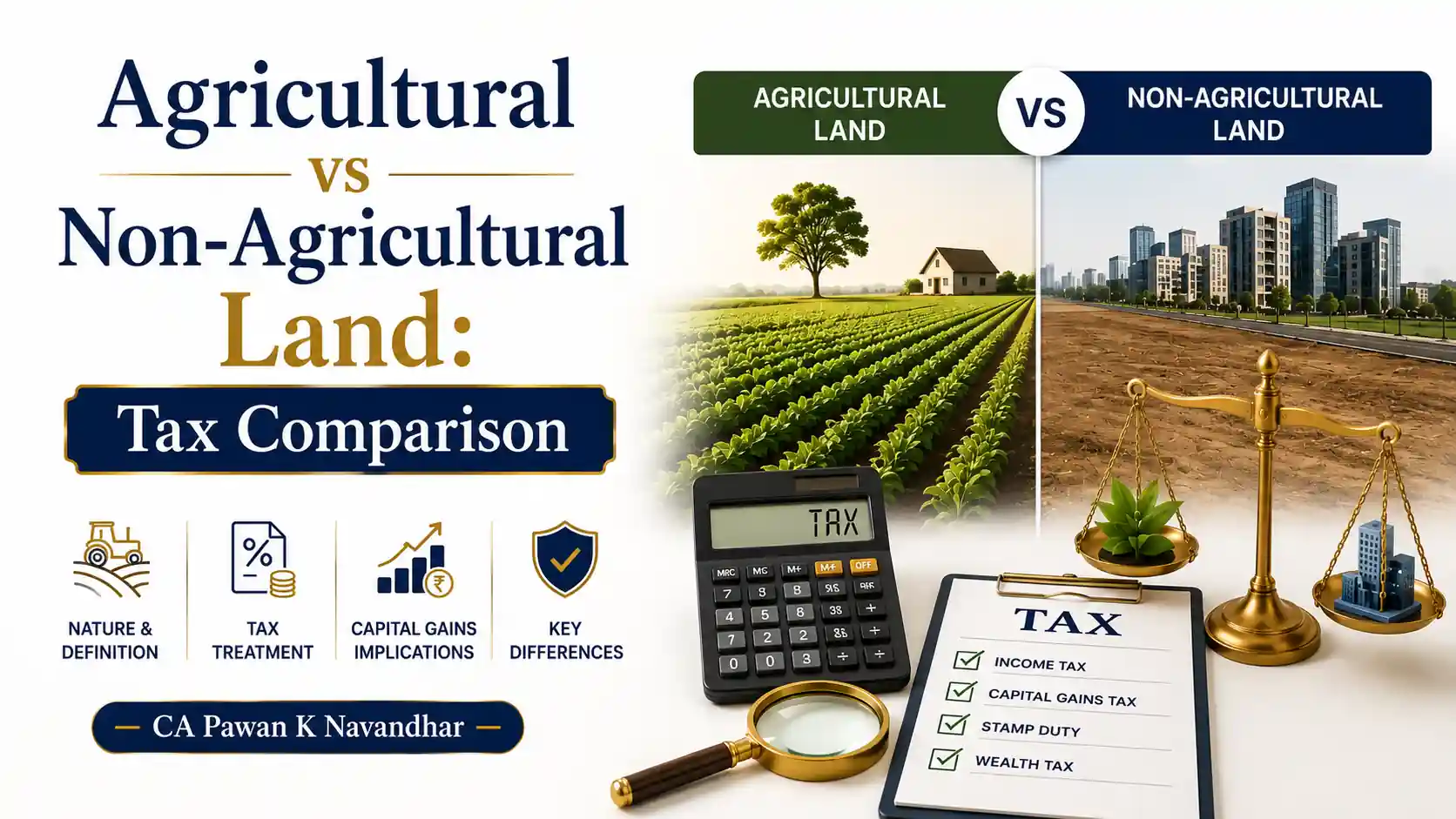
Agricultural vs Non-Agricultural Land: Tax Comparison
The Business Decision
A business owner is planning to invest surplus funds in land. Two options are available - an agricultural plot on the outskirts of a growing city and a nearby non-agricultural plot with commercial development potential.
Another family is preparing to sell inherited land and assumes that every land sale is taxed in the same way.
Both situations involve a common mistake.
Many investors focus on the purchase price, future appreciation, or development opportunities while overlooking one crucial factor - the tax treatment of the land itself.
The classification of land as agricultural or non-agricultural can significantly influence tax liability, capital gains, documentation requirements, and long-term investment returns.
The real decision is not simply which land is cheaper or likely to appreciate faster.
It is:
Do you fully understand the tax consequences before buying or selling the land?
Making the right decision at the beginning can prevent costly tax surprises later.
Why This Decision Matters
Land is often viewed as one of the safest long-term investments.
However, unlike many financial assets, the taxation of land depends on several factors, including:
- The nature of the land.
- Its location.
- Whether it qualifies as agricultural land under the Income Tax Act.
- The purpose for which it is held.
- The circumstances of its sale.
Many taxpayers incorrectly assume:
- "Agricultural land is always tax-free."
- "Every land sale attracts capital gains tax."
- "Changing land use has no tax implications."
These assumptions can lead to poor financial planning and unexpected tax liabilities.
For business owners, investors, developers, and families managing inherited property, understanding these differences is essential before entering into any transaction.
Tax planning should begin before signing the sale agreement - not after filing the Income Tax Return.
Understanding the Tax Position
The Income Tax Act treats agricultural and non-agricultural land differently for taxation purposes.
Whether a land transaction attracts tax depends on various factors, including the classification and location of the land.
Certain agricultural land may not be treated as a capital asset under the Income Tax Act, meaning its transfer may not attract capital gains tax, subject to the applicable conditions.
On the other hand, non-agricultural land is generally treated as a capital asset, and profits arising from its transfer may attract capital gains tax according to the applicable provisions.
The classification of land should never be assumed based solely on its appearance or current use.
Official land records, revenue documents, location, and applicable legal provisions all play an important role in determining the correct tax treatment.
Before buying or selling land, verifying its legal classification is an important step in tax planning.
Comparing the Available Choices
When evaluating land investments, buyers generally compare two broad categories.
Option 1: Agricultural Land
Agricultural land may offer favourable tax treatment in certain situations, depending on its classification and location.
However, buyers should verify whether the land actually qualifies under the applicable tax provisions instead of relying solely on local descriptions.
Option 2: Non-Agricultural Land
Non-agricultural land is commonly purchased for residential, commercial, or industrial development.
While it may offer greater development opportunities, profits from its transfer are generally subject to the applicable capital gains provisions.
Option 3: Converting Agricultural Land
Some investors purchase agricultural land with the intention of converting it for commercial or residential use.
Such decisions should not be driven only by future appreciation.
The tax implications of conversion and eventual sale should also be evaluated carefully.
Option 4: Inherited Land
Inherited land requires careful review before sale.
The tax consequences depend on factors such as the classification of the land, acquisition history, holding period, and applicable provisions.
Professional evaluation before selling inherited property can prevent costly mistakes.
Practical Business Examples
Example 1: Sale of Agricultural Land
A farmer sells agricultural land that satisfies the applicable conditions under the Income Tax Act.
Before assuming the proceeds are exempt from capital gains tax, the classification and location of the land are carefully verified.
Proper documentation supports the tax position.
Example 2: Commercial Land Investment
A business owner purchases non-agricultural land for constructing a warehouse.
Several years later, the land is sold at a substantial profit.
Since the property is a capital asset, the gain is evaluated under the applicable capital gains provisions.
Example 3: Family-Owned Land
A family inherits land from previous generations.
Before entering into a sale agreement, they obtain professional advice to determine whether the land qualifies as agricultural land under the relevant tax provisions.
This prevents incorrect tax assumptions.
Example 4: Land Conversion
An investor purchases agricultural land intending to convert it into residential plots.
Before beginning development, the investor evaluates both regulatory approvals and future tax implications.
Tax planning becomes part of the investment strategy rather than an afterthought.
Example 5: Startup Purchasing Land
A manufacturing startup acquires industrial land for expansion.
Understanding the tax treatment before acquisition helps management evaluate the project's overall financial viability.
Factors Every Owner Should Consider
Before buying or selling land, every taxpayer should evaluate several important factors.
Is the Land Correctly Classified?
Do not rely on verbal representations.
Verify classification through official land and revenue records.
Does the Location Matter?
The location of the land may influence its treatment under the Income Tax Act.
Proper verification is essential before planning any transaction.
Is Documentation Complete?
Maintain:
- Sale deed.
- Purchase deed.
- Revenue records.
- Land classification documents.
- Valuation reports, where applicable.
- Payment records.
- Government approvals.
Strong documentation supports smoother tax compliance.
What Is the Investment Objective?
Buying land for farming, commercial development, investment, or business expansion may involve different financial and tax considerations.
The investment purpose should align with long-term business goals.
Have Future Tax Costs Been Considered?
Purchase price alone should not drive the investment decision.
Potential capital gains implications, future development costs, and compliance obligations should also be evaluated.
Should Professional Advice Be Obtained?
High-value land transactions often involve complex legal, tax, and regulatory issues.
Obtaining professional advice before execution usually costs far less than correcting mistakes later.
Recommended Course of Action
Rather than asking,
"Which land pays less tax?"
Property buyers and business owners should ask,
"Which investment best aligns with my business objectives while remaining fully tax compliant?"
A practical approach includes:
✔ Verify the legal classification of the land.
✔ Review applicable tax implications before purchase.
✔ Maintain complete ownership and transaction records.
✔ Evaluate future capital gains consequences before selling.
✔ Consider long-term business and investment objectives.
✔ Avoid making decisions based solely on tax benefits.
✔ Consult a Chartered Accountant before executing significant land transactions.
Good investment decisions are based on both commercial potential and sound tax planning.
Final Takeaway
The tax treatment of land is not determined simply by whether it is called agricultural or non-agricultural.
Its legal classification, location, intended use, and applicable provisions under the Income Tax Act all influence the eventual tax outcome.
For entrepreneurs, investors, founders, professionals, and business owners, understanding these distinctions before purchasing or selling land leads to better financial planning and fewer compliance risks.
Rather than viewing taxation as an obstacle, it should be considered an important factor in evaluating the overall profitability of a property investment.
A well-informed decision today can protect both your investment returns and your long-term financial objectives.